Editorial · Innovation & future flight
The Next Generation of Air Mobility: The Innovations That Actually Change Private Flight
Published 2026-08-17 · Last updated 2026-08-16 · SkyMatch Group editorial team · 7 min read
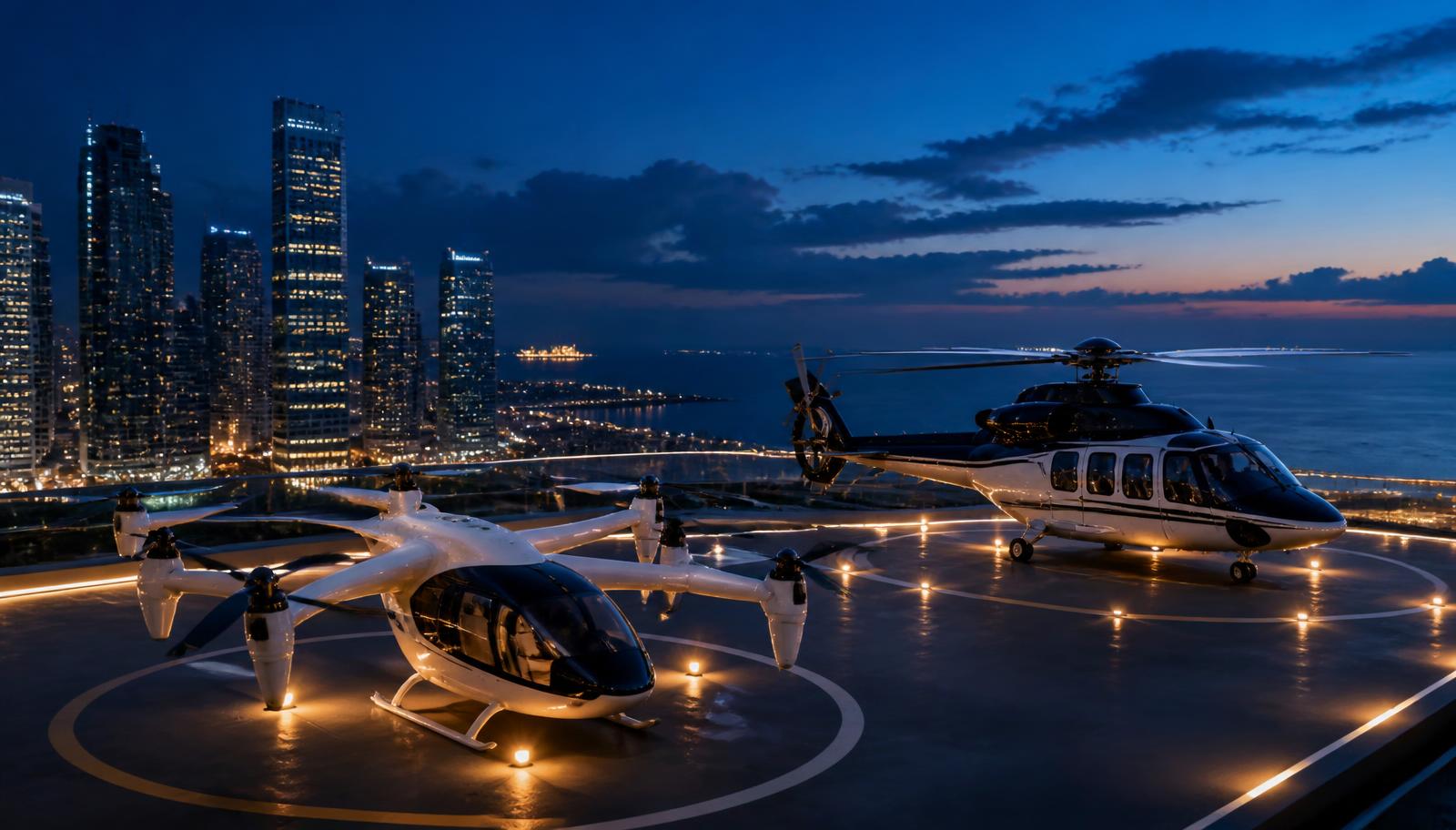
Electric propulsion, autonomy, digital sourcing and vertiport networks are rewriting short-sector private flight. A grounded 2026 view of what is real, what is coming, and what you can fly today.
SkyMatch does not operate, sell, broker or book eVTOL or autonomous flights. Helicopter charter with independent licensed operators is our active service; this article is informational.
Quick answer
What actually changes private flight in the next decade?
Four things move the needle: electric and hybrid propulsion on short sectors, progressive autonomy in the cockpit, vertiport networks that create new landing points, and digital sourcing that puts competing operator offers in front of a client in hours instead of days. Of those, only digital sourcing and modern twin-engine helicopters are fully available today.
Key takeaways
- Digital operator sourcing is live now and already compresses quoting time.
- Electric propulsion is realistic on short sectors first, not on long-range missions.
- Autonomy arrives as pilot augmentation long before pilotless passenger flight.
- Vertiport build-out is the slowest and most decisive variable.
Reviewed by the SkyMatch Group charter desk · Updated 17 August 2026
Quick answers
What is next-generation air mobility?
It is the shift from single, fuel-burning aircraft booked by phone to a networked short-sector system: electric and hybrid propulsion, digital sourcing and pricing, vertiport infrastructure, and progressively higher levels of automation. The aircraft is only one part; the network around it is the actual innovation.
Which innovations are real in 2026?
Digital sourcing, data-driven pricing, hybrid and more efficient turbine technology, advanced avionics and connectivity, and noise-reduction work are all in commercial service today. Fully certified electric passenger air taxis in scheduled city service are not.
What can I actually book right now?
Helicopter charter. Every route discussed here — airport to city, coast to island, circuit to resort — is flown today by licensed operators, subject to availability, weather and permits. eVTOL service remains informational until aircraft, operators and infrastructure are all certified in a given city.
The real shift is the network, not the aircraft
Every generation of aviation innovation is announced through a photograph of a new airframe. It is the least useful way to understand what is happening. The aircraft flying short private sectors in 2026 are recognisably the aircraft of a decade ago — safer, quieter, better instrumented, but the same idea. What has genuinely changed sits around them: how a flight is sourced, priced, scheduled, powered and permitted.
That distinction matters commercially. A passenger crossing from an airport to a coastal resort does not experience propulsion technology. They experience how long it took to get a firm answer, whether the aircraft was available on the day, whether the landing site was approved, and whether the flight went ahead in marginal weather. Those are network problems. The next generation of air mobility is, first and foremost, the industrialisation of that network — and only second a new type of machine.
Read honestly, the current moment is a transition. Electric aircraft are being tested at scale while the infrastructure and rulebooks that would let them fly commercially are still being written. Meanwhile the digital layer — sourcing, pricing intelligence, feasibility modelling — is already in daily production use and is quietly delivering most of the passenger-visible improvement.
Five innovations that actually matter
We track dozens of developments; five of them change outcomes for someone booking a short sector. Each is listed with an honest maturity status rather than a marketing claim.
| Innovation | Status | Why it matters |
|---|---|---|
| Electric & hybrid propulsion | Emerging | Distributed electric rotors cut moving parts, vibration and noise. Hybrid turbine-electric designs bridge the range gap while battery energy density catches up. The constraint is certification and charging infrastructure, not the motor. |
| Vertiport networks | Early build-out | Megawatt-scale charging, multiple stands, fast passenger flow and published arrival procedures. Without the ground network, no aircraft flies a commercial schedule — this is the true gating item. |
| Advanced autonomy | Assistive today | Envelope protection, automated approach and departure paths, real-time health monitoring and simplified controls. The near-term effect is a lower pilot workload and better safety margins on short, high-tempo sectors. |
| Digital sourcing & pricing | Live now | Structured operator coverage, route history and quote data replace the phone-and-inbox model. This is where passengers feel innovation first: a fast, comparable answer on a real route instead of a two-day wait. |
| Noise & community engineering | Live now | Quieter rotor designs, optimised approach angles and curfew-aware routing decide whether cities allow more flights at all. Acceptance, not thrust, is the limiting factor over dense urban areas. |
Notice the pattern: the two innovations already live are the two with no certification dependency. Software and operating procedure move at the speed of the company adopting them. Airframes move at the speed of the regulator — which is appropriate, and which is why credible forecasting in this sector is measured in rulemaking milestones rather than product launches.
A maturity timeline without dates
Fixed launch dates in advanced air mobility have a poor track record, so we describe horizons instead. Each stage below only begins when the previous one is genuinely complete in a specific city — not globally.
Digital sourcing, structured pricing history, modern twin-engine helicopters, quieter approach profiles, live feasibility and weather modelling on every request.
First certified electric types in limited, tightly supervised service in a small number of permissive markets; hybrid retrofits and expanded charging trials at existing heliports.
Multi-stand vertiports in a handful of cities, published low-level corridors, and mixed rotary + electric operations sharing the same ground infrastructure.
Denser networks, higher automation levels, and pricing that begins to reflect real operating-cost advantages once utilisation is high.
What changes on the ground
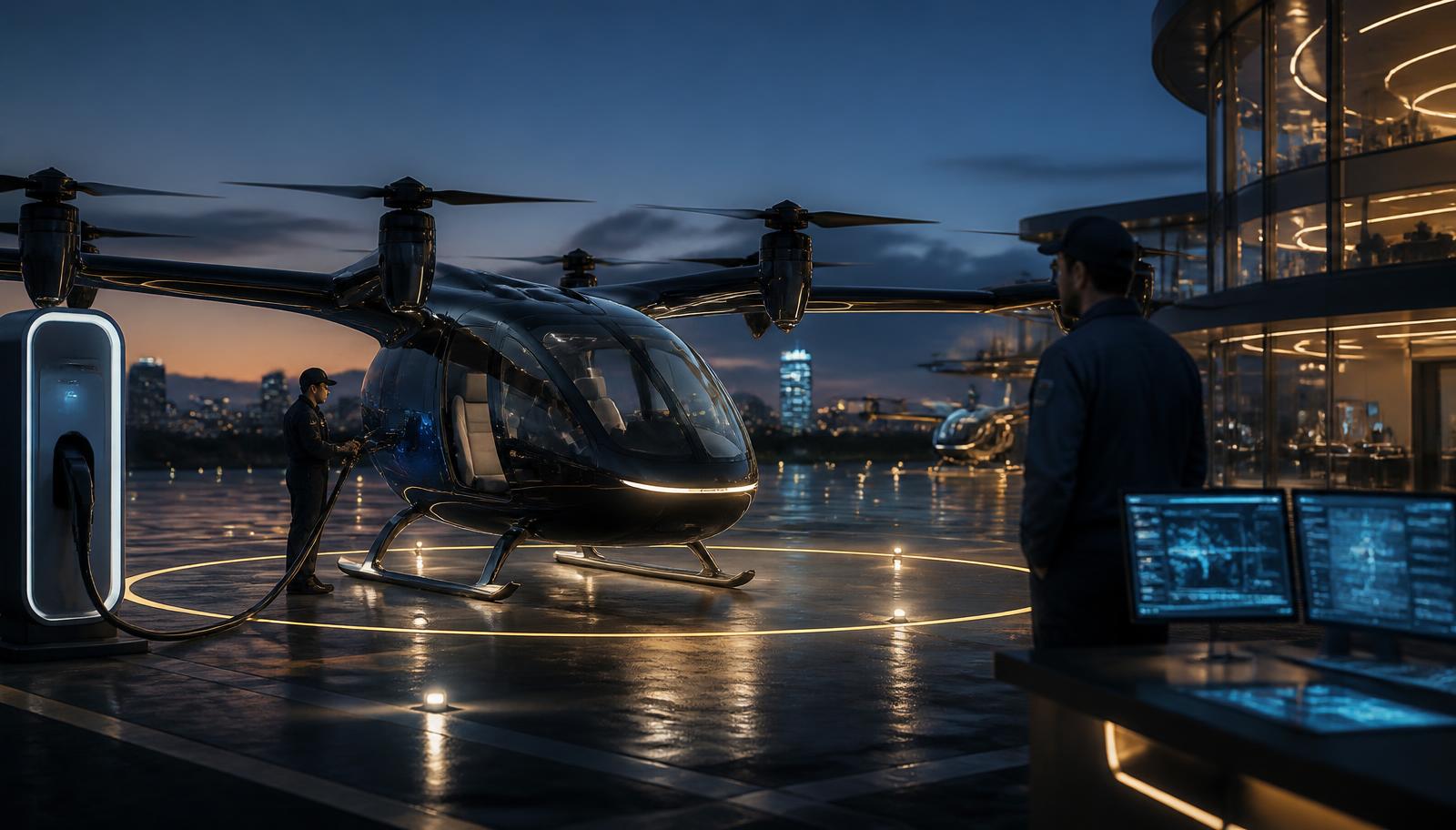
The unglamorous parts of a flight are where next-generation thinking shows up soonest. Turnaround discipline, energy logistics, crew rostering and dispatch decision-making all have to tighten before any city can support frequent short sectors, whatever powers the aircraft.
- Energy logistics. A turbine refuels in minutes; a battery needs planned charging windows, spare capacity and a grid connection sized for peaks. Scheduling becomes an energy problem as much as a crew problem.
- Predictive maintenance. Continuous health monitoring turns unscheduled groundings into planned interventions — the single largest lever on availability for a small fleet.
- Weather and feasibility modelling. Short sectors are cancelled by wind, visibility and cloud base far more often than by mechanical issues. Better modelling means fewer optimistic bookings and fewer disappointed passengers.
- Positioning intelligence. Empty repositioning legs remain the biggest hidden cost in short-sector flying. Matching demand to aircraft already in the right place is worth more than any efficiency gain in the powerplant.
Where innovation lands first
Adoption follows existing behaviour. The markets that move first are those already flying short private sectors, with regulators who have a working framework and geography that punishes ground transport.
Dense existing rotary traffic, an engaged regulator and short high-value hops between airports, marinas and island resorts.
Established heliport culture and an event-driven demand pattern on legs where road transfer is disproportionately slow.
Deep private-aviation demand, but central landing rights and noise policy remain the hard constraint on frequency.
Island crossings where a short flight replaces a ferry plus a drive, with strong seasonal peaks.
Compact geography, high-quality infrastructure and short airport-to-city corridors that suit fast rotations.
Tight airspace, capable authorities and offshore or cross-strait journeys well matched to vertical flight.
These are also the corridors where helicopter charter already performs: airport transfers, island crossings, event arrivals and yacht or resort connections. The future network will be built on top of proven demand, not invented alongside it.
Innovation in sourcing, not just in aircraft
The part of this industry SkyMatch works on is deliberately unromantic: matching a request to the right independent operator, quickly and neutrally. That is where a passenger feels modernisation today. Structured route history, independent operator coverage and recorded pricing evidence turn a request into a grounded answer instead of a guess, and remove the opacity that made short-notice charter frustrating.
It is also the layer that will absorb new aircraft types with the least friction. A network that can already describe a route, a landing site, an operator's real coverage and a comparable price does not need rebuilding when the aircraft on that route changes. That is why we treat digital sourcing as the foundation of next-generation air mobility rather than a side feature — and why our Air Taxi / eVTOL programme is an informational and readiness track, not a sales channel.
What you can fly today
Everything described above as available now is available now. Every route mentioned is flown by licensed independent operators, subject to availability, weather, permits and operator approval. If your journey is an airport transfer, an island crossing, an event arrival or a yacht connection, the aircraft already exists and the answer is a request away.
Matched with licensed independent operators on your exact route.
Flight time, feasibility and passenger planning tools for short sectors.
FAQ
What is next-generation air mobility?
It is the shift from single, fuel-burning aircraft booked by phone to a networked short-sector system: electric and hybrid propulsion, digital sourcing and pricing, vertiport infrastructure, and progressively higher levels of automation. The aircraft is only one part; the network around it is the actual innovation.
Which innovations are real in 2026?
Digital sourcing, data-driven pricing, hybrid and more efficient turbine technology, advanced avionics and connectivity, and noise-reduction work are all in commercial service today. Fully certified electric passenger air taxis in scheduled city service are not.
What can I actually book right now?
Helicopter charter. Every route discussed here — airport to city, coast to island, circuit to resort — is flown today by licensed operators, subject to availability, weather and permits. eVTOL service remains informational until aircraft, operators and infrastructure are all certified in a given city.
Will electric aircraft make private flight cheaper?
Not immediately. Energy is a small share of the cost of a short sector; crew, maintenance, insurance, infrastructure and positioning dominate. Early electric service typically prices near existing rotary transfer, and any savings only reach passengers once fleets are large and utilisation is high.
Is autonomous passenger flight close?
Autonomy is arriving as assistance rather than replacement: envelope protection, automated approach, health monitoring and simplified single-pilot operation. Removing the pilot from a commercial passenger flight is a regulatory question, not only a technical one, and remains far behind the aircraft themselves.
How does helicopter charter benefit from these innovations today?
Through the network layer: faster operator sourcing, structured route and pricing history, better weather and feasibility modelling, quieter approach profiles, and digital quoting that compresses hours of brokering into a same-day answer.
Does SkyMatch sell eVTOL or autonomous flights?
No. SkyMatch arranges helicopter charter with licensed independent operators. The Air Taxi / eVTOL section is informational and tracks future availability only.
Get notified when eVTOL air taxis become real
Nothing here is for sale yet. Join the SkyMatch eVTOL watch list and we will email you when certification milestones land, when vertiports open in your city, and when air taxi service actually becomes bookable. No spam, unsubscribe any time.
Recevoir les mises à jour eVTOL · Recibir novedades sobre eVTOL · eVTOL-Updates erhalten · Ricevi aggiornamenti eVTOL · eVTOL-updates ontvangen · Receber atualizações eVTOL · Получать обновления об eVTOL · تلقّي تحديثات eVTOL · לקבל עדכונים על eVTOL · Λάβετε ενημερώσεις eVTOL · eVTOL güncellemelerini alın · Otrzymuj aktualizacje eVTOL · Få eVTOL-uppdateringar
Related articles
Articles liés · Artículos relacionados · Verwandte Artikel · Articoli correlati · Gerelateerde artikelen · Artigos relacionados · Похожие статьи · مقالات ذات صلة · מאמרים קשורים · Σχετικά άρθρα · İlgili makaleler · Powiązane artykuły · Relaterade artiklar
eVTOL Air Taxis & Passenger Drones: The Future of Short-Distance Air Travel
The realistic pillar guide to electric air taxis: how the aircraft work, what certification still requires, how they compare with helicopter charter, and when service could plausibly begin.
Dubai · London · New York · Paris · 14 min
Vertiports & Air Taxi Cities: Which Markets Fly eVTOL First
What a vertiport actually is, the readiness criteria that decide launch order, and a market-by-market view of the cities most likely to see early commercial eVTOL operations.
Dubai · Abu Dhabi · London · Paris · 9 min
How to Prepare for an eVTOL Air Taxi Flight: A Traveller’s Guide
Booking differences, strict weight and luggage limits, vertiport check-in, weather cancellations and why every air taxi plan needs a helicopter or ground fallback.
Dubai · London · Paris · New York · 10 min
Continue reading
Poursuivre la lecture · Seguir leyendo · Weiterlesen · Continua a leggere · Verder lezen · Continuar a ler · Читать далее · مواصلة القراءة · המשך קריאה · Συνέχεια ανάγνωσης · Okumaya devam edin · Czytaj dalej · Fortsätt läsa
- Air taxi & eVTOL hubStatus, comparison with helicopters and the future network strategy.
- Vertiports & air taxi citiesLanding infrastructure and which markets are likely to fly first.
- Future network partnersFor operators, vertiport developers and eVTOL manufacturers.
- Fly today by helicopterAir taxi is not bookable yet — helicopter charter is available now.
Related helicopter reading
- Helicopter vs private jetHow short-sector aircraft choices are made today, before eVTOL enters the mix.
- Single vs twin-engine helicoptersRedundancy and safety logic that will shape eVTOL certification expectations.
- Our global operator networkThe same neutral matching model we are extending to future eVTOL operators.
- How helicopter charter is pricedCost structure context for comparing future air taxi economics.