Editorial · Future air mobility
Vertiports and Air Taxi Cities: Which Markets Will Fly eVTOL First
Published 2026-08-16 · Last updated 2026-08-16 · SkyMatch Group editorial team
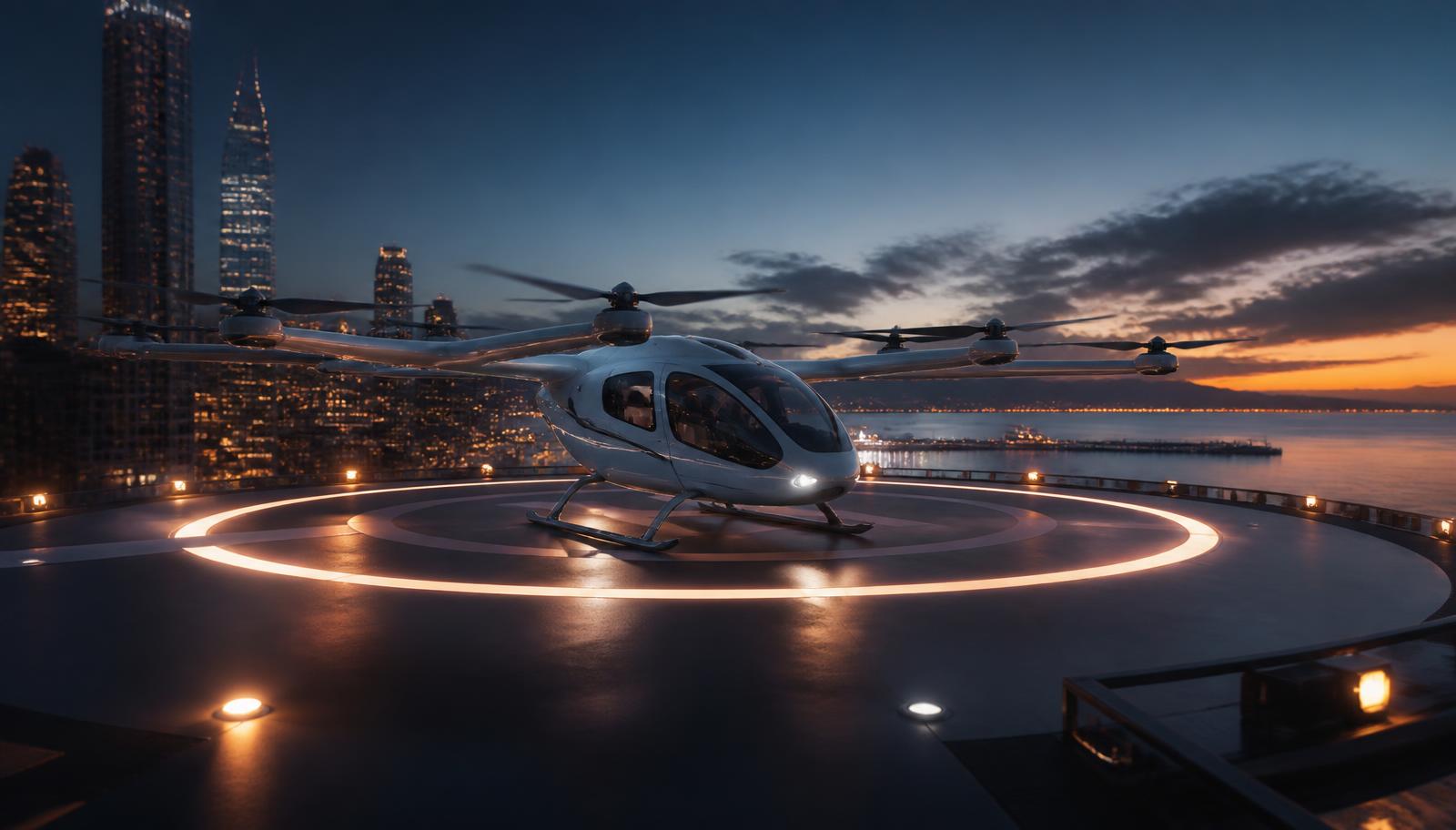
How vertiports, airspace rules and charging decide which cities get eVTOL air taxis first — and why helicopter charter still covers those routes today. SkyMatch editorial.
SkyMatch does not operate, sell, broker or book eVTOL or air-taxi flights. Helicopter charter is our active service. This article is informational.
Quick answer
Which cities will fly eVTOL air taxis first?
The first commercial eVTOL markets are the cities that already have a regulator-backed programme, funded vertiport sites and dense short-hop demand — Dubai and Abu Dhabi lead, with Singapore, Riyadh, Paris, London, New York and Los Angeles in the second wave. A vertiport is the deciding constraint: without certified landing infrastructure, no route can open.
Key takeaways
- Vertiport availability, not aircraft supply, determines launch order.
- Gulf cities lead on regulator alignment and funded infrastructure.
- Airport-to-city shuttles are the first commercially viable route type.
- Existing helipad networks give helicopters a decade-long head start on the same corridors.
Reviewed by the SkyMatch Group charter desk · Updated 17 August 2026
Quick answers
What is a vertiport?
A vertiport is a ground site designed for vertical takeoff and landing aircraft: a load-bearing pad, approach and departure paths clear of obstacles, passenger handling, and — for electric aircraft — high-power charging. It is the piece of infrastructure that decides whether an eVTOL service can exist in a city at all.
Which cities will get air taxis first?
Cities that already combine three things: existing rotary-wing traffic and helipads, a regulator actively working on vertical-flight rules, and short, congested, high-value journeys such as airport-to-centre or coast-to-island hops. That profile fits places like Dubai, Abu Dhabi, Singapore, Riyadh, Paris, London and several US metros — but no launch date is certain in any of them.
Can I book a vertiport flight today?
No. Commercial eVTOL passenger service requires a certified aircraft type, an approved operator and permitted infrastructure. Until all three exist in a given city, there is nothing lawful to book. Helicopter charter covers the same city-pair journeys today.
What is a vertiport?
Almost every conversation about electric air taxis focuses on the aircraft. That is the wrong end of the problem. Aircraft are being built and tested in numbers today; what does not yet exist, in almost any city on earth, is the ground network they would need to fly a commercial schedule. That network is the vertiport.
A vertiport is not simply a rebranded helipad. A conventional heliport is designed around one large rotor, a fuel truck and a handful of movements per day. A vertiport for electric aircraft has to solve a different problem: many small aircraft, short flights, fast turnarounds, and an energy demand measured in megawatts rather than litres. In practical terms that means several elements have to coexist on one site.
- A certified landing area. Load-bearing surface, obstacle-free approach and departure funnels, and separation from surrounding buildings — the constraint that eliminates most attractive city-centre rooftops.
- Grid capacity. Charging several aircraft between rotations needs a high-power connection that most rooftops and marinas simply do not have without significant electrical works.
- Passenger handling. Security screening, weighing, boarding and weather holds, all compressed into minutes if the service is to feel like a taxi rather than an airline.
- Airspace integration. Published routes and procedures agreed with the local authority, so multiple aircraft can arrive and depart without ad-hoc coordination.
Every one of those is a planning, permitting and utility problem rather than an engineering one — which is why the honest answer to "when will air taxis launch?" is "wherever the ground network is finished first".
Which cities fly first
First movers will not be the largest cities, nor the ones with the loudest announcements. They will be the cities where flying already happens. Where helicopters routinely move passengers between an airport and a business district, three expensive things are already solved: the public accepts aircraft overhead, the regulator has a working framework for low-level commercial flight, and landing sites exist with owners who understand aviation.
The second signal is journey shape. Air taxis are useful on legs of roughly fifteen to eighty kilometres where the road alternative is disproportionately slow — a bay to cross, a mountain to skirt, a congested motorway, or a bridge that adds an hour at peak. A city with fast rail and short drives has little to offer a passenger paying a premium for fifteen minutes in the air.
The five readiness criteria
When we track a market internally, we score it on five things — the same five a serious operator would look at before committing aircraft.
- Regulatory posture. Does the authority have a published pathway for certifying the aircraft type and approving the operator?
- Existing rotary demand. Are people already paying to fly this leg by helicopter? Proven demand de-risks everything downstream.
- Landing infrastructure. Are there sites that can realistically be converted or built, with the grid connection to match?
- Geography. Water, terrain or congestion that makes the surface alternative genuinely painful.
- Community tolerance. Local noise politics decides how early, how late and how often aircraft may operate — and it has grounded rotary services in cities before.
Market watch list
The markets below are the ones we monitor. This is a watch list based on the criteria above, not a schedule, and no entry here implies a launch date or an available service.
| City | Country | Why it scores well |
|---|---|---|
| Dubai | United Arab Emirates | Dense existing helicopter traffic, a regulator publicly engaged with vertical-flight infrastructure, and short high-value hops between the airports, the marina and Palm Jumeirah. |
| Abu Dhabi | United Arab Emirates | Island geography, government-backed mobility programmes and a natural airport-to-corniche corridor. |
| Riyadh | Saudi Arabia | Large-scale new-build districts where landing infrastructure can be designed in rather than retrofitted. |
| Singapore | Singapore | Compact, heavily regulated airspace, strong aviation authority capability, and cross-strait and offshore journeys that suit short vertical flights. |
| Paris | France | Established heliport culture, an event-driven demand pattern, and the CDG–centre corridor that already justifies rotary transfer. |
| London | United Kingdom | One of Europe's deepest private-aviation markets, though noise policy and central landing rights remain the hard constraint. |
| New York | United States | Existing commercial helicopter shuttles between Manhattan and the airports give a proven demand baseline. |
| Los Angeles | United States | Extreme road congestion, thousands of rooftop pads, and a large helicopter fleet already flying short urban legs. |
| Miami | United States | Water crossings, island destinations and a yacht-driven premium market. |
| São Paulo | Brazil | The world’s busiest urban helicopter market by rooftop movements — infrastructure and behaviour already exist. |
| Tokyo | Japan | Dense rooftop helipad stock, strong domestic manufacturing interest and clearly defined airport corridors. |
| Sydney | Australia | Harbour and coastal geography where a short flight replaces a long drive. |
Charging, energy and turnaround
The economics of an air taxi live or die on utilisation. A helicopter refuels in minutes and can fly again immediately; an electric aircraft has to put energy back into a battery, and doing that quickly stresses both the pack and the site's electrical supply. Operators therefore have to choose between fast charging, which shortens battery life, and battery swapping, which demands more ground equipment and floor space.
This is also where weather bites. Reserve energy for a diversion is not optional, and on a hot day with headwinds the usable range of a small electric aircraft narrows noticeably. Expect early networks to be short, dense and conservative: a handful of proven legs flown many times a day, rather than an open map.
Noise and community acceptance
Distributed electric propulsion generally produces a different acoustic signature to a single main rotor — higher pitched, and typically quieter in the hover. Quieter is not silent, and the political question is frequency rather than decibels. A city that tolerates twenty helicopter movements a day may respond very differently to two hundred small aircraft. Curfews, approach paths over water and caps on movements are likely to shape early operations more than any technical limit of the aircraft.
What you can fly today
Every corridor described above is already flyable — by helicopter, now, with more seats and more luggage than any announced eVTOL. Airport-to-city transfers, island and coastal hops, yacht and marina connections, and event access are the same missions the air-taxi category is aiming at, and they are the missions SkyMatch arranges daily with independent licensed independent operators.
The vocabulary in other languages
Our clients research this category in many languages, and the terminology does not always translate cleanly. These are the terms most commonly used across our markets.
vertiport · taxi aérien électrique · eVTOL · hélicoptère à la demande
vertipuerto · taxi aéreo eléctrico · eVTOL · vuelo en helicóptero privado
Vertiport · elektrisches Lufttaxi · eVTOL · Hubschrauber-Charter
vertiporto · taxi aereo elettrico · eVTOL · volo in elicottero privato
vertiport · elektrische luchttaxi · eVTOL · helikoptercharter
vertiporto · táxi aéreo elétrico · eVTOL · fretamento de helicóptero
вертипорт · электрическое аэротакси · eVTOL · аренда вертолёта
منصة إقلاع عمودي · تاكسي جوي كهربائي · eVTOL · تأجير طائرة هليكوبتر
ורטיפורט · מונית אוויר חשמלית · eVTOL · טיסת מסוק פרטית
κάθετο αεροδρόμιο · ηλεκτρικό αεροταξί · eVTOL · ναύλωση ελικοπτέρου
vertiport · elektrikli hava taksi · eVTOL · helikopter kiralama
vertiport · elektrisk flygtaxi · eVTOL · helikoptercharter
FAQ
What is a vertiport?
A vertiport is a ground site designed for vertical takeoff and landing aircraft: a load-bearing pad, approach and departure paths clear of obstacles, passenger handling, and — for electric aircraft — high-power charging. It is the piece of infrastructure that decides whether an eVTOL service can exist in a city at all.
Which cities will get air taxis first?
Cities that already combine three things: existing rotary-wing traffic and helipads, a regulator actively working on vertical-flight rules, and short, congested, high-value journeys such as airport-to-centre or coast-to-island hops. That profile fits places like Dubai, Abu Dhabi, Singapore, Riyadh, Paris, London and several US metros — but no launch date is certain in any of them.
Can I book a vertiport flight today?
No. Commercial eVTOL passenger service requires a certified aircraft type, an approved operator and permitted infrastructure. Until all three exist in a given city, there is nothing lawful to book. Helicopter charter covers the same city-pair journeys today.
How is a vertiport different from a heliport?
A heliport is designed around one large rotor and a fuel bowser. A vertiport adds electrical capacity — often megawatt-scale — plus multiple stands so aircraft can charge while others load, and tighter passenger flow for short, frequent rotations.
How many passengers will an air taxi carry?
Most announced designs target one pilot plus roughly four passengers, with limited luggage. That is smaller than a light twin helicopter, which is one reason the two categories are complementary rather than interchangeable.
Will air taxis be cheaper than a helicopter transfer?
Not necessarily at launch. Early service typically prices closer to premium ground or existing rotary transfer while fleets are small and infrastructure is being paid for. Any operating-cost advantage only reaches passengers once volume and utilisation are high.
Does SkyMatch sell eVTOL flights?
No. SkyMatch arranges helicopter charter with licensed independent operators. The Air Taxi / eVTOL section is informational and tracks future availability only.
Continue reading: eVTOL air taxis and the future of short-distance air travel, airport helicopter transfers or the helicopter planning calculators.
Related articles
Articles liés · Artículos relacionados · Verwandte Artikel · Articoli correlati · Gerelateerde artikelen · Artigos relacionados · Похожие статьи · مقالات ذات صلة · מאמרים קשורים · Σχετικά άρθρα · İlgili makaleler · Powiązane artykuły · Relaterade artiklar
Next-Generation Air Mobility: The Innovations That Actually Change Private Flight
Electric propulsion, autonomy, vertiport networks and digital sourcing — an honest 2026 maturity map of what is live now, what is coming, and what you can fly today.
Dubai · Abu Dhabi · London · Paris · 7 min
eVTOL Air Taxis & Passenger Drones: The Future of Short-Distance Air Travel
The realistic pillar guide to electric air taxis: how the aircraft work, what certification still requires, how they compare with helicopter charter, and when service could plausibly begin.
Dubai · London · New York · Paris · 14 min
How to Prepare for an eVTOL Air Taxi Flight: A Traveller’s Guide
Booking differences, strict weight and luggage limits, vertiport check-in, weather cancellations and why every air taxi plan needs a helicopter or ground fallback.
Dubai · London · Paris · New York · 10 min
Continue reading
Poursuivre la lecture · Seguir leyendo · Weiterlesen · Continua a leggere · Verder lezen · Continuar a ler · Читать далее · مواصلة القراءة · המשך קריאה · Συνέχεια ανάγνωσης · Okumaya devam edin · Czytaj dalej · Fortsätt läsa
- Air taxi & eVTOL hubStatus, comparison with helicopters and the future network strategy.
- Vertiports & air taxi citiesLanding infrastructure and which markets are likely to fly first.
- Future network partnersFor operators, vertiport developers and eVTOL manufacturers.
- Fly today by helicopterAir taxi is not bookable yet — helicopter charter is available now.
Related helicopter reading
- Helicopter vs private jetHow short-sector aircraft choices are made today, before eVTOL enters the mix.
- Single vs twin-engine helicoptersRedundancy and safety logic that will shape eVTOL certification expectations.
- Our global operator networkThe same neutral matching model we are extending to future eVTOL operators.
- How helicopter charter is pricedCost structure context for comparing future air taxi economics.
Get notified when eVTOL air taxis become real
Nothing here is for sale yet. Join the SkyMatch eVTOL watch list and we will email you when certification milestones land, when vertiports open in your city, and when air taxi service actually becomes bookable. No spam, unsubscribe any time.
Recevoir les mises à jour eVTOL · Recibir novedades sobre eVTOL · eVTOL-Updates erhalten · Ricevi aggiornamenti eVTOL · eVTOL-updates ontvangen · Receber atualizações eVTOL · Получать обновления об eVTOL · تلقّي تحديثات eVTOL · לקבל עדכונים על eVTOL · Λάβετε ενημερώσεις eVTOL · eVTOL güncellemelerini alın · Otrzymuj aktualizacje eVTOL · Få eVTOL-uppdateringar