Editorial · Future air mobility
eVTOL Air Taxis: How Passenger Drones Could Change Short-Distance Air Travel
Published 2026-08-16 · Last updated 2026-08-16 · SkyMatch Group editorial team
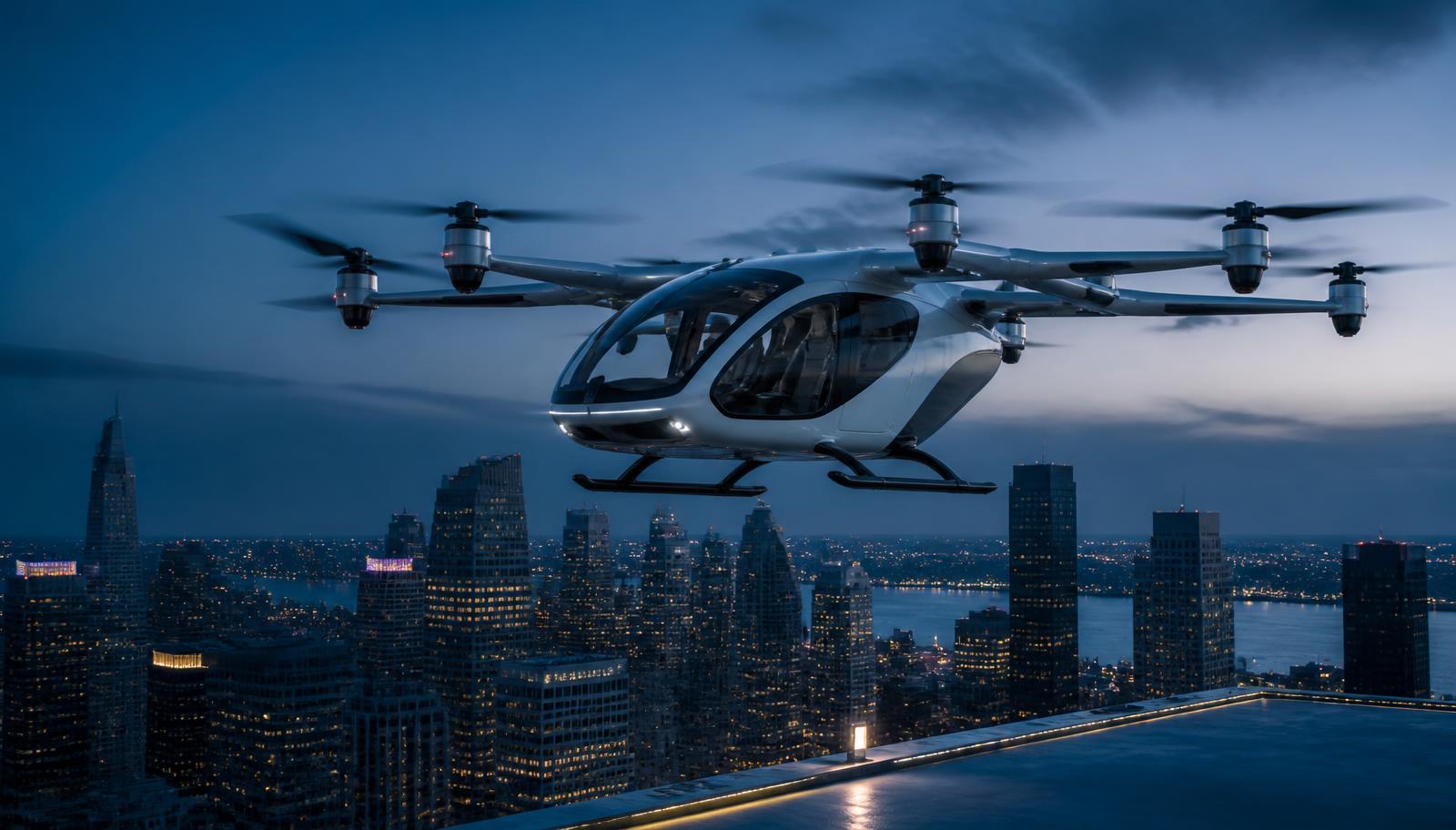
A grounded guide to eVTOL air taxis: what electric vertical takeoff aircraft are, how passenger drone terminology differs, how an air-taxi journey could work, and where helicopters stay ahead. Published by SkyMatch.
SkyMatch does not operate, sell, broker or book eVTOL or air-taxi flights. Helicopter charter is our active service. This article is informational.
Quick answer
When will eVTOL air taxis actually carry passengers?
Type certification, pilot training pipelines and vertiport infrastructure — not the aircraft themselves — set the timeline. Early commercial eVTOL services are expected in a handful of prepared markets such as Dubai, Abu Dhabi and Singapore, expanding gradually afterwards. Until then, helicopter charter remains the only aircraft that flies the same short city and resort sectors today.
Key takeaways
- Certification and infrastructure, not battery technology alone, gate the launch date.
- Launch markets are those with regulator support and funded vertiports.
- Payload and range limits will make eVTOL complementary to, not a replacement for, helicopters.
- Any near-term air taxi plan still needs a helicopter or ground fallback.
Reviewed by the SkyMatch Group charter desk · Updated 17 August 2026
Introduction
Vertical flight solves a specific problem: it removes the runway. That single property is why the helicopter, an aircraft type first certified for commercial passenger work in the middle of the twentieth century, still dominates short point-to-point passenger movement in cities, over water and into places with no aviation infrastructure at all. A helicopter can lift from a hotel lawn, an offshore deck, a yacht helipad or a rooftop in São Paulo, cross terrain that would take hours to drive, and set down inside the destination rather than at an airport twenty kilometres from it.
The reason a new aircraft category is emerging is not that this stopped working. It is that the cost structure of rotary flight is stubborn. Turbine engines, gearboxes and rotor systems are expensive to buy, expensive to maintain and expensive to crew, and noise limits how often a machine may operate over a populated area. Electric propulsion offers a different set of trade-offs — fewer moving parts, a different acoustic signature, potentially simpler maintenance — and a decade of battery, motor and flight control development has made small electric aircraft plausible in a way they were not before.
What follows is a deliberately sober look at that category: what an eVTOL actually is, how the vocabulary works, what a passenger journey might look like, and where helicopters keep a decisive advantage. It contains no launch dates, no fares and no claims about certifications, because the honest answer to most timing questions today is that they depend on regulators and infrastructure rather than on aircraft design.
What is an eVTOL?
eVTOL stands for electric vertical takeoff and landing. Four ideas define the category.
- Vertical takeoff and landing. The aircraft does not need a runway. It rises vertically from a pad, transitions to forward flight and lands vertically again — the same operational freedom that makes helicopters useful in cities.
- Electric propulsion. Motors are powered by onboard batteries, or in hybrid concepts by a small generator charging them. Energy density, not engineering ambition, is what limits how far these aircraft are designed to fly.
- Distributed propulsion. Instead of one main rotor, most designs use several smaller rotors or ducted fans. Some tilt forward for cruise; others separate lift rotors from cruise propellers. Spreading thrust across many units changes the noise signature and offers redundancy if one unit fails.
- Piloted or autonomous concepts. Some aircraft are designed around a pilot on board; others target eventual autonomous or remotely supervised operation. Autonomy is a regulatory question as much as a technical one, and passenger-carrying autonomy is the harder of the two.
The fifth component sits on the ground. A vertiport is a landing site built for these aircraft: a pad or set of pads, high-power electrical charging, passenger handling, security screening where required, maintenance capability and a way to integrate departures and arrivals with surrounding air traffic. Without vertiports at both ends of a journey, an air-taxi route does not exist regardless of how good the aircraft is.
Passenger drone vs eVTOL vs helicopter
The three terms are used loosely in the press, which makes the market harder to understand than it needs to be.
- Helicopter. A specific, mature, certified aircraft category with a global fleet, an established maintenance and fuel network, and well-understood operating rules. Available now, everywhere.
- eVTOL. A description of the aircraft: how it is powered and how it takes off. It says nothing about who flies it or what the service model is.
- Air taxi. A description of the service: a short, on-demand passenger flight between two points, typically with a small number of seats. An air taxi could in principle be flown by a helicopter — in São Paulo and New York, effectively it already is.
- Passenger drone. Popular shorthand, usually implying autonomy or remote piloting and a very small aircraft. It is not a regulatory category, and using it interchangeably with "eVTOL" causes most of the confusion in public discussion.
"Urban air mobility" and "advanced air mobility" are the umbrella terms regulators and planners use for the whole field, the second being broader because it includes regional and cargo operations rather than just city flying.
How air taxi travel could work
The passenger journey described below is the industry model most developers and city planners work from. It is not a description of a service you can use today, and it will not look identical in every market.
- Search the route. A traveller enters an origin and destination and the platform checks whether an approved air route exists between them, rather than assuming any two points can be connected.
- Find the nearby vertiport. Because vertiports will be scarce at first, the practical origin is rarely the front door. The first leg is a short ground transfer.
- Match to a licensed operator. The platform's job is to confirm the operator holds the approvals for that aircraft type in that jurisdiction — the same verification discipline that applies to helicopter charter.
- Verify passenger and baggage limits. Payload matters more on an electric aircraft than on a turbine one, because mass directly consumes range. Expect firm weight declarations and tight baggage allowances.
- Transfer to the aircraft. Identity checks, a safety briefing and boarding, handled at the vertiport terminal.
- The flight itself. A short city or airport sector, flown on a defined corridor agreed with air traffic control.
- Ground connection at the destination. The final leg by car. An air taxi is a link in a chain, not a door-to-door replacement for it — which is exactly how airport helicopter transfers already work.
Where air taxis may be most useful
The economics favour journeys that are short in distance but long in time. Those cluster in a predictable set of situations:
- Airport to city centre, where a twenty-kilometre trip can absorb an hour of road time twice a day.
- City to nearby city, on corridors too short for a productive airline sector and too long to drive comfortably.
- Congestion bypass, in metropolitan areas where ground alternatives are structurally unreliable.
- Resort and coastal transfers, where the road follows a bay the aircraft can cross directly.
- Business districts, connecting financial centres to executive airports.
- Major events, where temporary demand spikes overwhelm road capacity — the pattern already visible around Grand Prix weekends, film festivals and boat shows, which SkyMatch handles today by helicopter.
- Islands and short water crossings, where the ferry sets the pace of the whole itinerary.
- Connecting transport hubs, linking airports, rail terminals and ports within one metropolitan area.
Every one of those is a mission helicopters fly commercially now. That overlap is the clearest evidence that demand exists; it is also why the categories will compete on cost and infrastructure rather than on novelty.
eVTOL vs helicopter
A fair comparison acknowledges that one category is in service and the other is in development. The table below stays qualitative for that reason.
| Dimension | Helicopter | eVTOL air taxi |
|---|---|---|
| Typical mission | Airport and city transfers, island and resort hops, offshore, medical, survey, heavy lift and remote access. | Short urban and airport-to-city passenger hops are the mission most developers describe first. |
| Expected distance | Short sectors through to several hundred kilometres, with refuelling stops extending the day. | Designs published so far target short ranges limited by battery energy; longer sectors are not the stated use case. |
| Passenger capacity | Roughly 3–4 seats on light singles up to 12–19 on medium and heavy twins. | Most announced passenger configurations are small — a pilot plus a handful of seats, subject to certification. |
| Ground infrastructure | Existing helipads, heliports, airports, FBOs, yachts, hotels and approved off-airport sites. | Vertiports with electrical charging and passenger handling are still being planned and built in most cities. |
| Noise | Rotor noise is a known planning constraint and drives curfews and approach routes in many cities. | Distributed electric propulsion is expected to change the noise signature; real-world community impact is still being measured. |
| Propulsion | Turbine or piston engines burning jet fuel or avgas, with a mature global fuel and maintenance network. | Electric or hybrid-electric motors, typically several of them, powered by onboard batteries. |
| Availability today | Available now worldwide — this is the service SkyMatch coordinates. | Not generally available for commercial passenger booking; availability is emerging market-by-market. |
| Regulatory status | Long-established certification, operator approvals and crew licensing frameworks. | New aircraft category: type certification, operator approval, airspace integration and local permissions are still being worked through by regulators. |
The honest summary: eVTOL concepts are optimised for a narrow, repeatable, short urban mission, and helicopters are general-purpose aircraft. Helicopters are likely to remain essential for longer range, remote and offshore destinations, larger payloads, operational flexibility, medical and emergency work, and every market that will not have vertiport infrastructure for a long time — which is most of the world.
Regulation and certification
Commercial passenger flight is permission-based. At a high level, four separate approvals have to line up before an air taxi may sell a seat, and they are granted by different processes on different timelines.
- Type certification of the aircraft by the relevant civil aviation authority, against standards that had to be written for a configuration that did not previously exist.
- Operator approval, covering maintenance organisation, crew training, operating procedures and safety management.
- Crew and autonomy rules — who may fly the aircraft, what training and licensing applies, and, for autonomous concepts, what supervision framework is acceptable.
- Airspace and local permission, including routes, noise rules, curfews, and the planning consent that lets a vertiport exist at a specific address.
Because the fourth item is municipal rather than aviation-wide, availability will arrive city by city. Nothing in this article is legal advice; anyone planning an operation should confirm requirements with the civil aviation authority in the relevant jurisdiction.
Safety
The only defensible statement about safety today is procedural: carrying paying passengers requires a certified aircraft type and an approved operator, and that requirement exists precisely because performance claims from manufacturers are not evidence. Helicopter operations have decades of incident data, published safety programmes and mature crew training pipelines behind them. eVTOL types are still accumulating theirs. Claims in either direction — that electric aircraft are inherently safer because they have fewer moving parts, or inherently less safe because batteries are new — outrun the available evidence and should be treated as marketing.
Infrastructure
Infrastructure, not aircraft, is the likely bottleneck. A functioning air-taxi network needs vertiports located where passengers actually want to start and finish, which in most cities means expensive land with neighbours. Each site needs high-power electrical supply, since charging an aircraft between rotations demands far more capacity than a typical building draws. It needs passenger terminals with security and accessibility arrangements; maintenance capability, either on site or nearby, so an aircraft with a fault is not stranded on the pad; integration with air traffic control that works when several operators fly the same corridor; and emergency procedures for battery incidents, diversions and unplanned landings. Aircraft can be built faster than cities can approve, wire and staff these places.
Cost
No credible fare exists for a service that is not selling tickets, and any published figure today is a projection rather than a price. What can usefully be described are the variables that will set the eventual fare:
- Aircraft utilisation — how many revenue sectors a machine flies per day, including charging turnarounds.
- Route length and structure — whether the aircraft repositions empty between legs.
- Passenger load — a small cabin spreads fixed cost across few seats.
- Operator costs — crew, insurance, training and safety management.
- Vertiport fees — landing, parking, charging and passenger handling.
- Electricity — cheaper per unit of energy than jet fuel in most markets, but priced against peak-demand charges at the vertiport.
- Maintenance and battery life — how often packs must be replaced, and what that costs.
- Certification and compliance — a fixed overhead amortised across the fleet.
- Ground transfers — the car legs at each end are part of what the passenger actually pays for the journey.
The same logic governs helicopter pricing, which is why SkyMatch quotes each mission individually rather than publishing a fare table.
Environmental considerations
Electric propulsion removes fuel combustion at the point of use, so local emissions along the flight path are eliminated and the acoustic profile changes. Both are genuine differences. Neither makes the flight environmentally free. Lifecycle impact depends on how the electricity is generated, on battery manufacture and recycling, and on what the journey replaces — a flight substituting for a car trip has a different balance than one creating a journey nobody would otherwise have made. Noise is also not the same as quiet: distributed rotors shift the frequency and character of the sound, and whether communities find the result acceptable is being measured, not assumed. Sustainability claims for this category should be read with the same scepticism applied to any other transport mode.
Will eVTOL replace helicopters?
Probably not. The two categories are more likely to coexist and serve different missions. If electric air taxis succeed, they will do so on dense, short, repeatable urban routes with purpose-built infrastructure at both ends. Helicopters will continue to serve everything that does not fit that shape: longer sectors, remote and offshore destinations, heavier payloads and outsize loads, medical and emergency response, firefighting, survey and utility work, and the very large share of the world that will never have a vertiport. The most likely outcome is a broader vertical-flight market in which a traveller in a well-equipped city gains a new option while everyone else keeps the one that already works.
SkyMatch and the future of air mobility
SkyMatch currently focuses on helicopter charter: one mission brief, independent licensed independent operators sourced worldwide, and coordination through to completion. We do not operate, sell or broker eVTOL flights, and we do not hold agreements with air-taxi operators. What we have built is an informational Air Taxi / eVTOL section so travellers can follow the category honestly — what it is, what would have to be true for it to launch in a given city, and how it compares with the aircraft that can fly them today.
If certified air-taxi service becomes commercially available in a market, the discovery and verification work is the same work we already do: confirm the operator's approvals, match the aircraft to the mission, and be clear with the traveller about what is and is not possible.
FAQ
What is eVTOL in simple terms?
An electric vertical takeoff and landing aircraft: it rises and lands vertically without a runway and is driven by electric motors, usually several of them distributed across the airframe, rather than by a fuel-burning engine turning one main rotor.
Can you book an eVTOL flight today?
In most markets, no. Commercial passenger service needs a certified aircraft type, an approved operator, integrated airspace, usable vertiports and local permission. Until those exist in a given city, there is no lawful commercial service to book there.
When will flying taxis be available?
There is no reliable universal date. Timing is set by certification progress, operator approvals and infrastructure in each city, so availability will appear market-by-market rather than everywhere at once. Treat confident launch dates with caution.
Is an eVTOL safer than a helicopter?
There is no evidence base to make that claim in either direction. Helicopters have decades of accumulated operational data; eVTOL types are still being certified. What can be said is that both require certification and operational approval before carrying paying passengers.
How is a passenger drone different from an air taxi?
The terms overlap in everyday use. "Passenger drone" usually implies a small, autonomous or remotely supervised aircraft; "air taxi" describes the service — a short on-demand passenger flight — which may be flown by a pilot on board.
Will eVTOL replace helicopters?
Probably not. The two categories are more likely to coexist. Helicopters keep the advantage on range, payload, remote and offshore destinations, medical and emergency work, and in any market without vertiports or charging.
Does SkyMatch book eVTOL flights?
No. SkyMatch currently focuses on helicopter charter. The Air Taxi/eVTOL section tracks and prepares for future commercial availability.
Continue reading: helicopter vs private jet, airport helicopter transfers or the helicopter planning calculators.
Related articles
Articles liés · Artículos relacionados · Verwandte Artikel · Articoli correlati · Gerelateerde artikelen · Artigos relacionados · Похожие статьи · مقالات ذات صلة · מאמרים קשורים · Σχετικά άρθρα · İlgili makaleler · Powiązane artykuły · Relaterade artiklar
Next-Generation Air Mobility: The Innovations That Actually Change Private Flight
Electric propulsion, autonomy, vertiport networks and digital sourcing — an honest 2026 maturity map of what is live now, what is coming, and what you can fly today.
Dubai · Abu Dhabi · London · Paris · 7 min
Vertiports & Air Taxi Cities: Which Markets Fly eVTOL First
What a vertiport actually is, the readiness criteria that decide launch order, and a market-by-market view of the cities most likely to see early commercial eVTOL operations.
Dubai · Abu Dhabi · London · Paris · 9 min
How to Prepare for an eVTOL Air Taxi Flight: A Traveller’s Guide
Booking differences, strict weight and luggage limits, vertiport check-in, weather cancellations and why every air taxi plan needs a helicopter or ground fallback.
Dubai · London · Paris · New York · 10 min
Continue reading
Poursuivre la lecture · Seguir leyendo · Weiterlesen · Continua a leggere · Verder lezen · Continuar a ler · Читать далее · مواصلة القراءة · המשך קריאה · Συνέχεια ανάγνωσης · Okumaya devam edin · Czytaj dalej · Fortsätt läsa
- Air taxi & eVTOL hubStatus, comparison with helicopters and the future network strategy.
- Vertiports & air taxi citiesLanding infrastructure and which markets are likely to fly first.
- Future network partnersFor operators, vertiport developers and eVTOL manufacturers.
- Fly today by helicopterAir taxi is not bookable yet — helicopter charter is available now.
Related helicopter reading
- Helicopter vs private jetHow short-sector aircraft choices are made today, before eVTOL enters the mix.
- Single vs twin-engine helicoptersRedundancy and safety logic that will shape eVTOL certification expectations.
- Our global operator networkThe same neutral matching model we are extending to future eVTOL operators.
- How helicopter charter is pricedCost structure context for comparing future air taxi economics.
Get notified when eVTOL air taxis become real
Nothing here is for sale yet. Join the SkyMatch eVTOL watch list and we will email you when certification milestones land, when vertiports open in your city, and when air taxi service actually becomes bookable. No spam, unsubscribe any time.
Recevoir les mises à jour eVTOL · Recibir novedades sobre eVTOL · eVTOL-Updates erhalten · Ricevi aggiornamenti eVTOL · eVTOL-updates ontvangen · Receber atualizações eVTOL · Получать обновления об eVTOL · تلقّي تحديثات eVTOL · לקבל עדכונים על eVTOL · Λάβετε ενημερώσεις eVTOL · eVTOL güncellemelerini alın · Otrzymuj aktualizacje eVTOL · Få eVTOL-uppdateringar