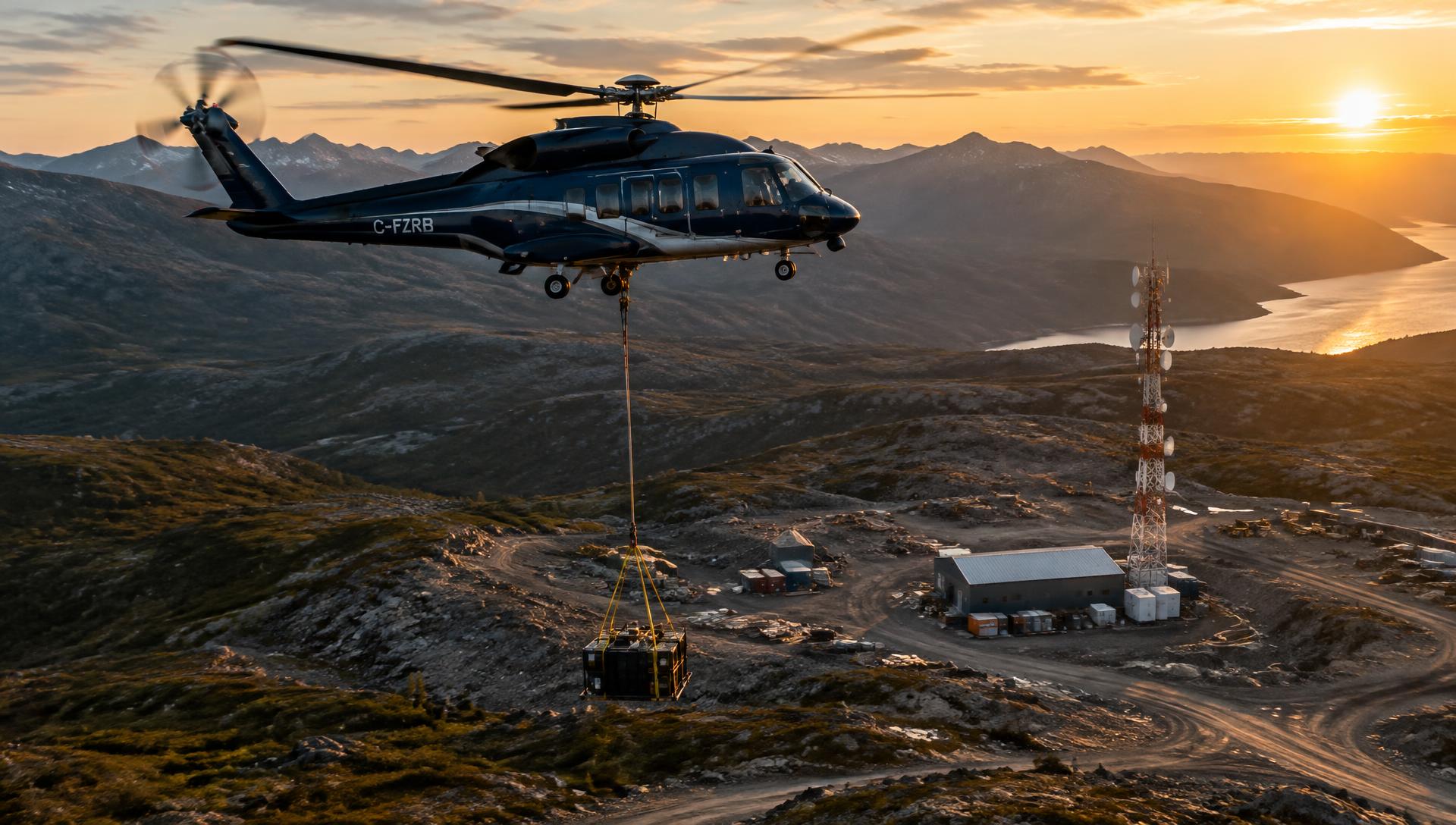
Special helicopter missions & special services for companies
A special helicopter mission is any commercial flight task that goes beyond a standard passenger transfer: precision external-load lifts, tower and antenna work, AOG and industrial-downtime response, remote-site logistics, commissioning support and urgent technical personnel transport. SkyMatch Group is an independent broker — we do not operate aircraft. We qualify your requirement, source licensed helicopter operators and coordinate the mission under human review. Every flight is performed and contracted by the licensed operator, subject to aircraft availability, permits and weather.
SkyMatch Group is an independent helicopter charter broker and mission-coordination concierge. We do not operate aircraft. All flights are performed by licensed independent operators, subject to availability, permits, weather and local aviation regulation.
Companies in construction, telecommunications, energy, mining and logistics regularly face work that ground transport cannot reach — or cannot reach in time. This guide explains what special helicopter missions are, which mission types companies source most often, how pricing actually works, and what to prepare before requesting a quote. It is written for procurement teams, project managers and engineers, and it stays deliberately honest: a helicopter is a tool, not a default answer.
The special-mission types companies source most
Each mission type below has its own operational logic, documentation and operator requirements. SkyMatch coordinates all of them through one human-reviewed request.
External-load and cargo-hook operations
Precision placement or removal of loads on a long line: HVAC units, tower sections, concrete buckets, generators and drill parts. Requires a cargo-hook-approved operator, certified load calculations and coordinated ground rigging.
External-load mission supportTelecommunications tower construction and antenna installation
Lifting tower sections, antennas and microwave dishes to sites with no crane access — including emergency restoration after storms, fires or landslides.
Remote telecom tower missionsAOG and industrial-downtime response
Moving a replacement part, tooling or a specialist to a grounded aircraft or a stopped production line as quickly as possible, subject to operator availability, permits and weather.
Industrial downtime RFQRemote-site logistics
Repeated lift cycles for camps, shelters, fuel, cable drums and consumables where no road exists, or where building access would be disproportionate to the work.
Remote-site logistics supportCommissioning and construction support
Positioning equipment and specialist crews during plant commissioning, shutdowns and turnarounds that run against tight contractual windows.
Commissioning helicopter charterUrgent technical personnel transport
Flying engineers, inspectors or medical specialists to sites with no practical surface connection — offshore platforms, mountain infrastructure, isolated plants.
Urgent specialist transportAerial survey and inspection support
Helicopter access for powerline, pipeline and infrastructure survey work, coordinated with the operator's approved sensor, low-level and airspace procedures.
When a helicopter is the right tool — and when it is not
Special helicopter missions are worth evaluating when a project meets one or more of the conditions below.
No practical road access
The site has no usable track, or the existing track cannot carry the equipment, the crane or the crew volumes the work requires.
Mountain, high-altitude or island terrain
Ridges, summits, islands and high plateaus where density altitude decides which loads are realistically possible.
Very short work windows
Planned outages, contractual deadlines or weather-dependent windows that cannot absorb weeks of ground mobilization.
Minimal ground disturbance
Protected or sensitive areas where cutting access tracks and building crane pads is not acceptable.
A helicopter is not automatically faster or cheaper than a crane or a road solution. When ground logistics look like the better plan, we say so — before you spend money on aircraft time.
How pricing for special missions actually works
There is no honest fixed price list for special missions. Every quote is built per mission by the operator that will fly it, after reviewing the load, the site, the dates and the regulatory environment. Two missions that look identical on a map can price very differently once positioning, altitude and crew duty limits are considered.
What we can promise is transparency: when SkyMatch presents an operator offer, the cost drivers are visible, and where a ground alternative is cheaper we flag it. For planning purposes, the factors below drive the total.
Main cost drivers
- Aircraft class and certified payload at the site's density altitude
- Positioning and ferry time from the operator's base
- Flight time, lift cycles and expected daily utilization
- Crew size, ground support, rigging team and fuel logistics
- Permits, authority fees and site-owner approvals
- Staging area preparation, security and crowd separation
- Weather windows and standby days
- Insurance and mission-specific risk assessment
How SkyMatch sources and coordinates a special mission
Every request passes through the same human-reviewed chain. Nothing is auto-confirmed, and no aircraft is promised before an operator has reviewed the mission.
- You submit the mission brief through the RFQ form or WhatsApp — objective, location, load, dates.
- A SkyMatch coordinator reviews the requirement, asks the technical questions operators will ask, and qualifies the mission.
- We source licensed operators with the right aircraft class, cargo-hook or mission approvals and regional presence.
- Operator documentation — AOC, insurance, crew and aircraft records — is reviewed at sourcing and confirmed before booking.
- You receive a coordinated offer with the mission plan, responsibilities and cost drivers clearly separated.
- The licensed operator contracts and flies the mission, including the final go / no-go decision.
What to prepare before requesting a quote
The faster these points are answered, the faster operators can price and plan. Missing data is the most common cause of delay.
- Mission objective and the deliverable expected on the ground
- Site location — coordinates if available — and nearest airfield or staging area
- Load weight, dimensions, centre of gravity and rigging drawings for external loads
- Preferred dates, time windows and deadline constraints
- Site access conditions, ground crew availability and lifting equipment on site
- Permits or approvals already in hand, and the site owner's contact
- Your procurement process and decision timeline
- A budget frame, if you have one — it helps us recommend honestly
Who is responsible for what
The split is simple and non-negotiable. The licensed operator owns the AOC, the aircraft, the crew, insurance, permits and the final go / no-go decision. The relevant aviation authority and site owner approve what happens in their airspace and on their ground.
SkyMatch qualifies, sources and coordinates. We do not certify, audit or operate aircraft, and we never release your contact details to an operator without an approved introduction. That separation is what keeps the sourcing independent.
Special missions for companies — frequently asked questions
Does SkyMatch operate the helicopters?
No. SkyMatch Group is an independent broker and human-reviewed coordination platform. Every mission is flown and contracted by a licensed independent operator that holds the required AOC, insurance and mission approvals.
How fast can a special mission be arranged?
As quickly as possible, subject to operator availability, permits and weather. A simple regional lift can sometimes be arranged in days; complex cross-border or high-altitude missions need more preparation. The honest answer is given during qualification, not after booking.
Who performs and contracts the flight?
The licensed operator. The operator owns the aircraft, crew, insurance, permits and the final go / no-go decision. SkyMatch coordinates the sourcing and the mission plan on your side.
How is the price of a special mission calculated?
Per mission, by the operator. The main drivers are aircraft class and payload at site altitude, positioning time, lift cycles, crew and ground support, permits, staging, weather windows and insurance. There is no fixed public price list because no two sites are equal.
Which languages can we work in?
SkyMatch coordinates in a multilingual environment and supports requests in major business languages. Technical documentation is handled in the operator's working language and yours, so nothing is lost between the boardroom and the landing site.
Can you support recurring or multi-site programmes?
Yes. Companies running tower rollouts, inspection seasons or multi-site construction can request programme-level coordination with qualified operators, subject to aircraft and crew availability across the schedule.
Planning guides and tools
Calculators return planning estimates only — not quotations. Aircraft availability, permissions, weather, landing access and operator terms are reviewed per mission.
Request a mission assessment
Send the mission brief — objective, site, load, dates. A human coordinator reviews it and responds as quickly as possible, subject to operator availability.