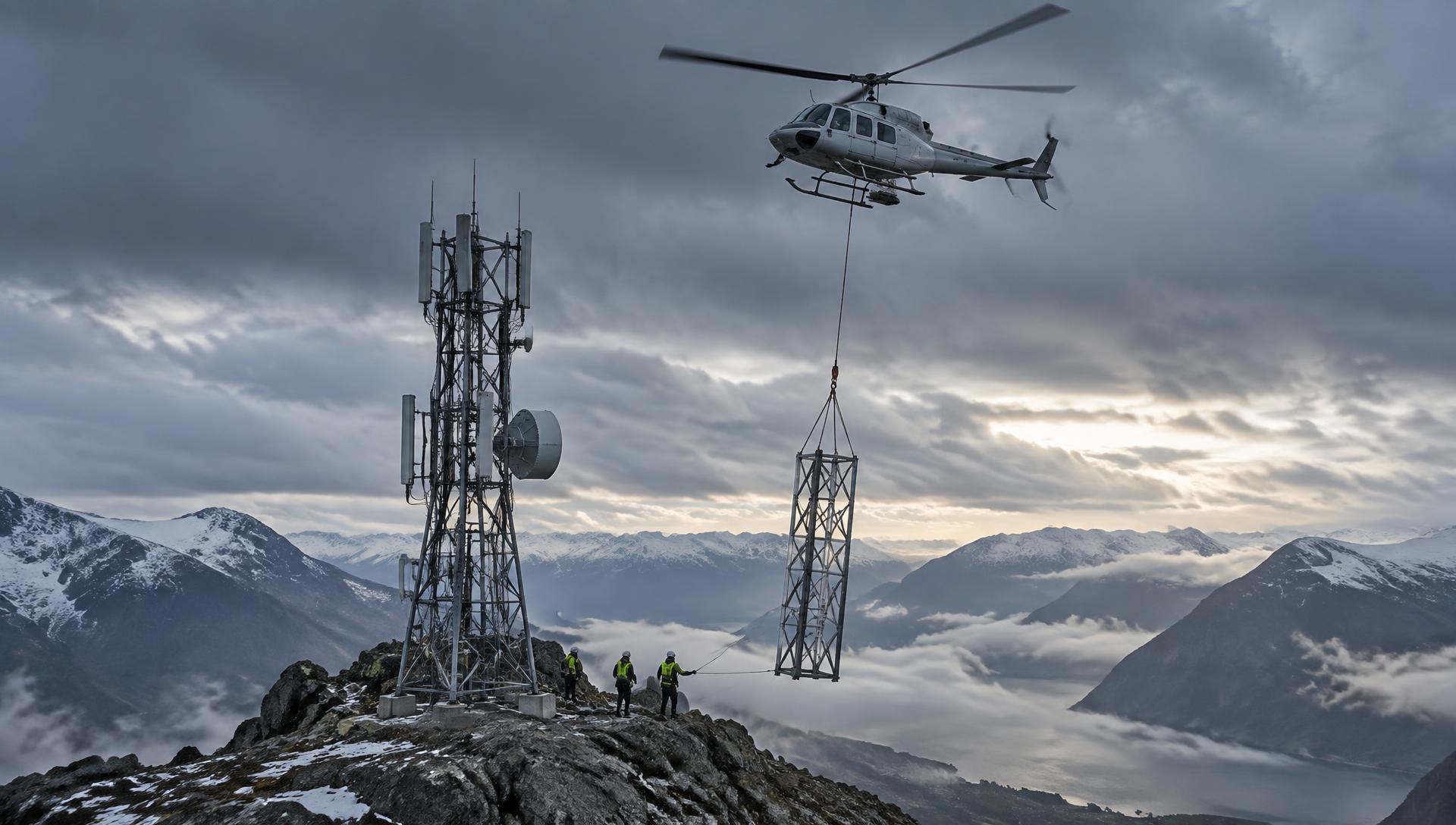
Helicopter Support for Remote Telecommunications Towers
Global sourcing and human-reviewed mission coordination for tower construction, antenna installation, emergency replacement and remote infrastructure operations.
When the road ends, SkyMatch finds the right aviation solution.
SkyMatch does not operate aircraft. We coordinate qualified requests with suitable licensed helicopter operators, subject to availability, permits, weather, aircraft capability and local aviation regulations.
When a helicopter becomes the right solution
Helicopter support is worth evaluating when the project has one or more of the conditions below. It is not the default answer, and we will say so when ground logistics look like the better plan.
No practical road access
Ridge-top, island and forest sites where building an access track or crane pad would cost more, take longer or require more permitting than flying the components in.
Mountain and high-altitude terrain
Sites where ground transport is limited by gradient, switchbacks, snow cover or seasonal closure, and where the working window is short.
Islands, deserts, forests and remote ridgelines
Locations reached today by barge, 4x4 convoy or foot, where each ground trip consumes a day and every delivery is weather-dependent.
Difficult crane access
Where a mobile crane cannot be set up, cannot reach the required radius, or where the ground bearing capacity and staging area are insufficient.
Short construction or outage windows
Network cutovers, permitted environmental windows and planned outages where the lifting phase has to be compressed into hours rather than weeks.
Existing tower replacement
Swapping sections, headframes or complete structures on a live site where ground access has degraded since the tower was originally built.
Minimal ground disturbance
Protected habitats, watersheds, archaeological zones and private land where a new access road is not acceptable to the landowner or regulator.
Emergency communications restoration
Storm, fire, flood, landslide or earthquake damage where a road is cut and the priority is restoring service, not optimising logistics cost.
Heavy or oversized components
Shelters, generators, battery banks, tower sections and headframes that exceed what can practically be carried to the site by hand or by light vehicle.
Precision placement
Antennas, microwave dishes and mounts that must be positioned onto an existing structure with a rigging crew already in place.
A helicopter is not automatically cheaper than ground logistics or a crane. Total project cost depends on where the aircraft has to be positioned from, payload and cycle count, distance between the staging area and the tower, altitude and temperature, weather exposure, permit requirements, staging-area preparation, ground and rigging crew, and what the crane alternative would actually cost including access works. Any responsible comparison is made on your specific site by qualified aviation and engineering professionals — not from a web page.
Mission types we coordinate
Each mission type below is sourced from licensed operators after human review. Aircraft, capability and availability are confirmed by the operator, never assumed here.
Telecom tower construction
Flying tower sections, foundations hardware, headframes and build materials to sites where a crane or access road is impractical.
Cell tower erection
Lift sequencing for monopole, lattice and guyed structures on greenfield and rooftop-adjacent remote sites.
Antenna installation
Placing panel antennas, RRUs, mounts and cable trays onto new or existing structures with a rigging crew on the tower.
Antenna replacement
Swap-out campaigns across multiple remote sites, where each visit has to be completed inside one flyable window.
Microwave dish installation
Positioning larger parabolic dishes and their mounting frames, where wind loading and alignment tolerance drive the method.
Broadcast tower support
Support for tall broadcast masts: section lifts, antenna elements, rigging material and crew and equipment movement.
Remote tower maintenance
Recurring access for inspection, battery and fuel replenishment, corrosion works, ice damage and structural repair.
Emergency tower restoration
Urgent sourcing after storm, fire, flood or seismic damage has cut the road to a site carrying critical traffic.
External-load operations
Cargo-hook and long-line work as a discipline: rigging, load calculations, cycle planning and ground-crew coordination.
Remote site freight
Repeat internal-cargo and sling cycles for consumables, tooling, cable drums and spares on a build or maintenance campaign.
Shelter and generator transport
Equipment shelters, gensets, fuel tanks and battery banks — the loads that usually decide which aircraft class is relevant.
Government and critical communications
Public-safety, defence-adjacent and emergency-network infrastructure handled under confidentiality, with procurement-ready documentation.
Mining and energy communications
Site communications, repeaters and microwave links across mine concessions, pipelines, wind farms and transmission corridors.
Remote infrastructure logistics
Multi-site programmes where towers are only one part of a wider remote-infrastructure delivery plan.
What SkyMatch coordinates
- Step 1
Collect the mission brief
Location and coordinates, dates, tower type and height, payload and load dimensions, lift count, passenger numbers, equipment and the project schedule.
- Step 2
Review technical feasibility
Terrain, elevation, access, staging area, landing zone, external-load requirement, cycle distance and weather exposure are reviewed before anything is sent out.
- Step 3
Source suitable operators
SkyMatch privately approaches licensed operators whose recorded capability, geography, permits and mission profile potentially match the requirement. Operator identities are not published.
- Step 4
Compare the mission options
Aircraft suitability, positioning, crew, fuel, permits, insurance requirements, ground logistics and scheduling are compared side by side.
- Step 5
Coordinate the commercial proposal
You receive a structured proposal, subject to operator confirmation and regulatory approval. Nothing is presented as confirmed before the operator confirms it.
- Step 6
Human-reviewed execution support
Communication runs between your project team, the SkyMatch coordinator and the selected operator. No unreviewed direct buyer-operator connection is created.
Customer and operator are never connected automatically. Contact details are released only after a SkyMatch review and an approved introduction.
Helicopter versus crane
A planning comparison, not a recommendation. Both methods are standard construction practice and the right answer depends entirely on your site.
| Criteria | Helicopter | Crane / ground plant |
|---|---|---|
| Road access | Not required for the lift itself; a staging area with vehicle access is still needed. | Requires a road or track able to carry the crane and its counterweights. |
| Mountain or remote terrain | Terrain matters mainly for approach, altitude performance and the landing or staging zone. | Often needs access works, platform construction or is simply not deliverable to the site. |
| Setup time | Short on site once the aircraft and rigging crew are in position. | Assembly, rigging and ground preparation can take days on a difficult site. |
| Mobilisation | Positioning flights from the operator's base are usually the dominant cost driver. | Transport, escorts, permits and access works are usually the dominant cost driver. |
| Ground disturbance | Limited to the staging area and the tower base. | Access track, crane pad and laydown area affect a larger footprint. |
| Heavy repeated lifts over a long duration | Each cycle carries flight cost; long campaigns can become expensive. | Usually more economical once it is standing and access already exists. |
| Precision placement | Achievable with an experienced long-line crew and a rigging team on the structure. | Very controllable where the crane can reach the required radius and height. |
| Emergency replacement | Can often reach a site whose access road is cut, subject to availability and weather. | Depends on the road being usable, which is frequently the reason for the outage. |
| Weather sensitivity | Wind, cloud base, visibility, icing and turbulence can stop a flying day entirely. | Wind limits apply to lifting, but a crew can often keep working around them. |
| Combined planning | Frequently used for the components that cannot be reached any other way. | Frequently used for the bulk of a build once material is on site. |
- Helicopters may be useful where roads, crane pads or long mobilisation are impractical, or where the working window is very short.
- Cranes may be the better answer where access is easy and repeated lifting is required over a long duration.
- Many projects are best delivered with a combined crane-and-helicopter strategy — helicopter for the inaccessible or time-critical elements, crane or ground plant for the rest.
- The final method selection must be made by qualified aviation and engineering professionals against your actual site data, loads and regulatory environment.
Mission detail pages
Helicopter Support for Telecom Tower Construction
Global helicopter sourcing and mission coordination for telecom tower construction: section lifts, headframes, foundations material and build logistics on sites without crane or road access.
Helicopter Antenna Installation and Replacement
Sourcing and coordination of helicopter support for antenna installation, RRU and mount placement and multi-site antenna replacement campaigns on remote and mountain towers.
Helicopter Access for Remote Tower Maintenance
Recurring helicopter access for remote communications-tower maintenance: crew movement, battery and fuel replenishment, corrosion and ice damage repair, structural inspection support.
Helicopter External-Load Operations for Infrastructure
How helicopter external-load and long-line operations are planned for infrastructure projects — load data, rigging, cycle planning, staging areas, permits — and how SkyMatch sources licensed operators.
Helicopter Support for Microwave Dish Installation
Helicopter sourcing and coordination for microwave dish and mounting-frame installation on remote and mountain communications towers, where crane access is impractical.
Helicopter Support for Emergency Telecom Restoration
Urgent helicopter sourcing and coordination for communications restoration after storm, fire, flood or seismic damage has cut road access to critical tower sites.
Helicopter Logistics for Remote Infrastructure Sites
Helicopter sourcing and coordination for remote site logistics: shelters, generators, fuel, cable drums, tooling and crew movement across multi-site infrastructure programmes.
Remote tower missions — questions answered
Can helicopters install communications tower sections?+
Yes — external-load helicopter operations are routinely used in the industry to place tower sections, headframes and structural components on sites without crane access. Whether it is feasible on your site depends on the section weight and dimensions, altitude and temperature, wind, the rigging plan and the operator's approvals. SkyMatch structures your requirement and sources licensed operators; the operator confirms the lift.
Can helicopters replace antennas on remote towers?+
Yes. Antenna and RRU swap-outs are a common external-load and crew-support task, usually combined with a rigging team working on the structure. The controlling factors are load weight, alignment tolerance, wind conditions and how many sites have to be completed inside one flyable window.
Can helicopters transport generators and shelters?+
Yes, within the payload capability of the aircraft the operator offers for your site conditions. Generators, equipment shelters, fuel tanks and battery banks are usually the loads that decide which aircraft class is relevant, because their weight at site altitude and temperature — not their weight at sea level — is what matters.
Can helicopters install microwave dishes?+
Yes. Larger parabolic dishes and their mounting frames are commonly placed by helicopter where crane access is impossible. Dish diameter creates significant wind loading during the lift, so the method statement and acceptable wind limits are defined by the operator and your engineers.
Can SkyMatch support emergency communications restoration?+
Yes, as a sourcing and coordination partner. We take your urgent requirement, review it, and approach licensed operators who may be able to respond. We cannot guarantee an aircraft, a response time or a permit — availability, weather and regulatory clearance are outside our control, and we will tell you honestly what we are seeing.
Do you operate the helicopter yourselves?+
No. SkyMatch is an independent global helicopter charter broker and mission-coordination concierge. We do not own aircraft, hold an AOC or operate bases. Every mission is flown by a licensed third-party operator that SkyMatch sources after human review.
Can you source helicopters internationally?+
Yes — sourcing is global, and the same brief can be run in more than one country. What varies by country is operator availability, external-load approvals, permit lead time and local aviation regulation, so feasibility is assessed per site rather than promised in advance.
What information is required for a commercial RFQ?+
Site location and coordinates, required dates or outage window, tower type and height, site elevation, maximum load weight and dimensions, number of lifts, distance from the staging area to the tower, road and crane access, landing-zone availability, passenger numbers, permit status and any engineering drawings. Missing items are normal — we will tell you which ones actually affect feasibility.
Is a helicopter always cheaper than a crane?+
No, and any provider claiming otherwise is guessing. A helicopter can be cheaper where access works, crane mobilisation or a long road build would dominate the budget, and more expensive where access already exists and many repeat lifts are needed. The comparison has to be made on your site with real positioning, payload and cycle data.
What permits are normally required?+
Typically some combination of external-load or sling-load authorisation, airspace coordination, landowner and land-management consent, local authority or environmental approval and site-specific safety documentation. The exact list depends on the country and the site. SkyMatch identifies what will be needed and coordinates with the operator; approvals themselves are issued by authorities, never by us.
How does altitude affect payload?+
Helicopter lifting performance falls as altitude and air temperature rise, so the same aircraft can lift substantially less on a hot day at a mountain-top site than at sea level in cool conditions. This is why site elevation and expected temperature are asked for early: they often decide the aircraft class before anything else does.
How does weather affect the mission?+
Wind, gusts, cloud base, visibility, icing and turbulence can stop external-load work even when the aircraft is on site. Realistic planning includes contingency days, a defined decision point each morning and an understanding of standby cost. We will not promise a date that weather can invalidate.
Can a project combine a crane and helicopter?+
Yes, and on remote sites it is often the most economical answer: helicopter cycles for the components that cannot be reached otherwise, ground plant or a crane for the rest of the build. Sequencing the two is part of the feasibility review.
Can you support mining, energy and government communications?+
Yes. Site communications, repeaters and microwave links for mine concessions, pipelines, wind farms, transmission corridors and public-safety networks are handled through the same structured mission brief, with procurement-ready documentation where a tender requires it.
Can you handle confidential infrastructure projects?+
Yes. Briefs can be run without naming your client or the end network, and operator identities are not published to you automatically either — introductions are released only after human review. Documents you send are handled as commercial-in-confidence.
How quickly can SkyMatch review a request?+
A reviewed response is prepared as quickly as possible, subject to operator availability and the completeness of the brief. We deliberately do not publish a fixed service-level time: an honest answer on a remote external-load mission depends on operators replying, not on us.
Discuss a remote infrastructure project
Send the site, the loads and the window. A SkyMatch coordinator reviews the brief before anything goes to an operator, and you will never receive a quote that an operator has not confirmed.
SkyMatch does not operate aircraft. We coordinate qualified requests with suitable licensed helicopter operators, subject to availability, permits, weather, aircraft capability and local aviation regulations.