Corporate project logistics
Corporate Helicopter Logistics for Remote Projects: Cost Drivers, Time Savings and Multi-Site Mission Planning
How project, engineering and corporate travel teams structure helicopter movements to remote sites — and what an operator needs before it can answer seriously.
Quick answer
How do companies plan helicopter logistics for remote project sites?
By treating it as an access and productivity decision rather than a fare comparison. Cost is built per mission from block time, positioning, aircraft class, crew duty, landing and handling, and ground time. The case is usually made in recovered team hours, schedule certainty and multi-site reach. SkyMatch is an independent broker; licensed third-party operators confirm aircraft, feasibility, landing permissions and price.
Key takeaways
- Positioning is often the largest cost element on a remote project mission.
- Multi-stop days are built backwards from daylight, fuel points, ground time and crew duty limits.
- Recovered person-hours, not the aircraft hour, is the number project teams defend internally.
- The final leg to a non-aerodrome site is where feasibility is actually decided.
- Larger groups move by rotation or multiple aircraft, subject to operator review.
Reviewed by the SkyMatch Group charter desk · Updated 22 September 2026
Short answer
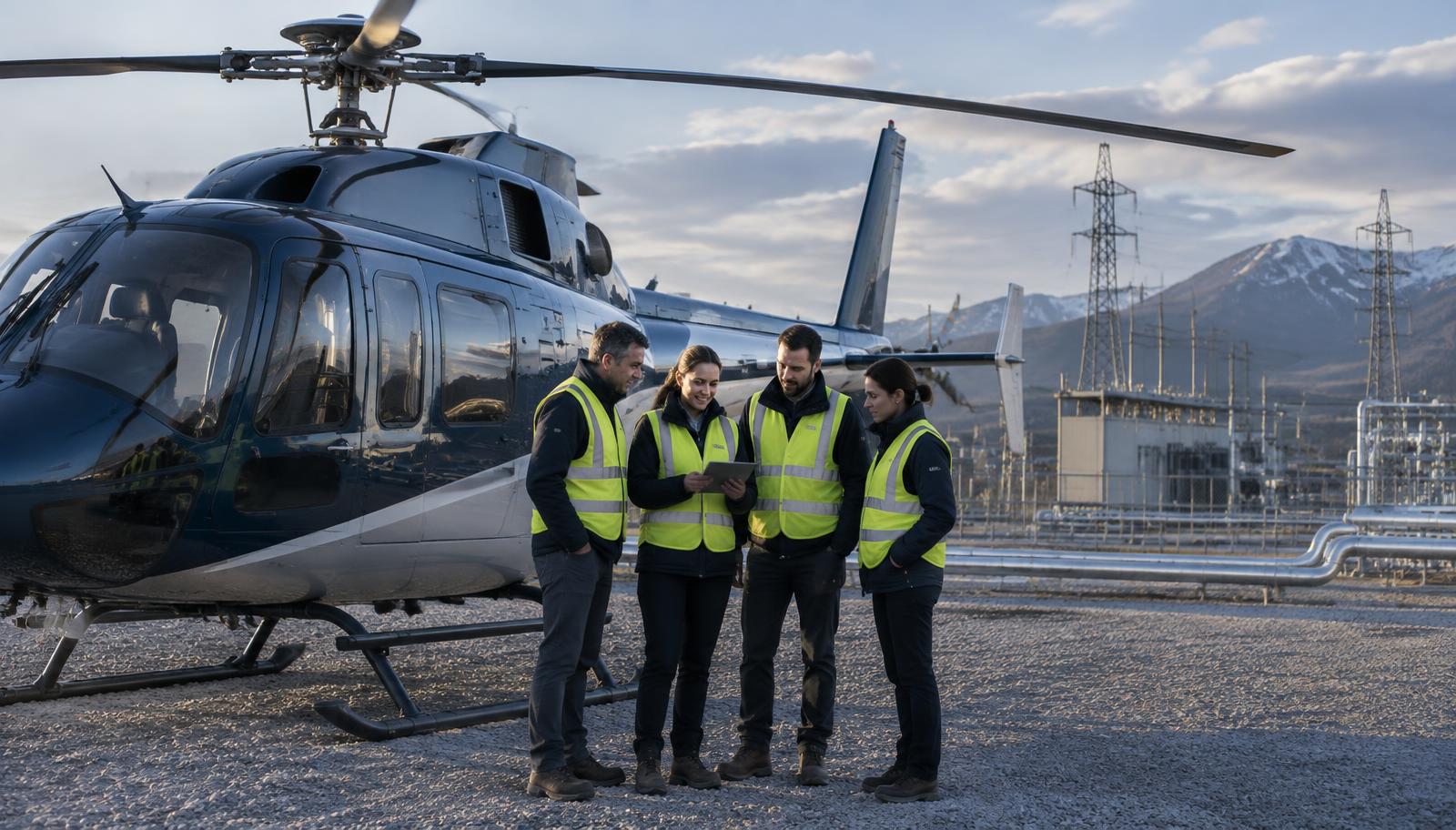
Corporate helicopter logistics moves project teams, executives, investors and light equipment to remote sites that road access serves poorly. Missions are evaluated on time, access, productivity, risk and coordination, not flight price alone. Cost is built per mission from block time, positioning, crew, handling and ground time. SkyMatch is an independent broker and aviation concierge; licensed third-party operators confirm aircraft, feasibility and pricing.
Who this is for
- Project directors and operations managers running remote build or maintenance programmes
- EPC and engineering contractors mobilising technical teams
- Utilities, telecom and tower companies serving distributed assets
- Mining and energy teams planning site visits, audits and rotations
- Executive assistants and corporate travel managers coordinating board and investor visits
Where corporate helicopter logistics is used
The pattern is consistent across industries: an asset or project site sits several road hours from the nearest usable airport, the people who must reach it are expensive and scarce, and the schedule has no slack. Typical missions include:
- Executive, investor and technical site visits — board, lender and due-diligence trips that must return the same day.
- Mining, energy, construction and infrastructure projects — and offshore-adjacent movements where the operator and regulator permit them.
- Multi-stop and multi-day logistics — several assets in one itinerary, or repeat sorties across a campaign.
- Team, light equipment and essential baggage movements — within the payload the aircraft can actually carry.
- Project inspections and urgent mobilisation — commissioning, outage and restoration work.
- Rotation concepts for larger groups — multiple sorties or aircraft, subject to operator review.
Sector detail lives on the industrial remote project hub, the mining charter guide and the offshore energy guide.
Cost drivers
Corporate quotations are built per mission, not per seat. The table below is what actually moves the number, and what an operator needs from you to price each element.
| Mission factor | Why it matters | What to provide |
|---|---|---|
| Block time | The operator charges the whole aircraft by time flown, including the sector back to base. | Origin, each stop and the realistic ground time at every site. |
| Positioning | Suitable aircraft are rarely based beside a remote project, so the empty sector matters. | Nearest airport, FBO or helipad, and whether an overnight on site is acceptable. |
| Aircraft class | Passenger count, baggage, elevation and temperature decide the type, not cabin preference. | Number of people with weights, plus equipment and baggage in kilograms. |
| Crew and duty | Duty limits and early or late working shape whether a day plan is legal and safe. | Earliest departure, latest return, and whether the schedule can flex. |
| Landing and handling | Airport, FBO and site charges, marshalling and any ground support all sit in the quotation. | Landing type at each point and who controls the site. |
| Waiting and rotations | Standby on the ground and repeat sorties change basing, fuel and crew planning. | Hours on site, number of rotations and number of project days. |
For structure and indicative ranges rather than a quotation, see the helicopter charter cost guide and corporate helicopter cost.
Time, productivity and recovered team hours
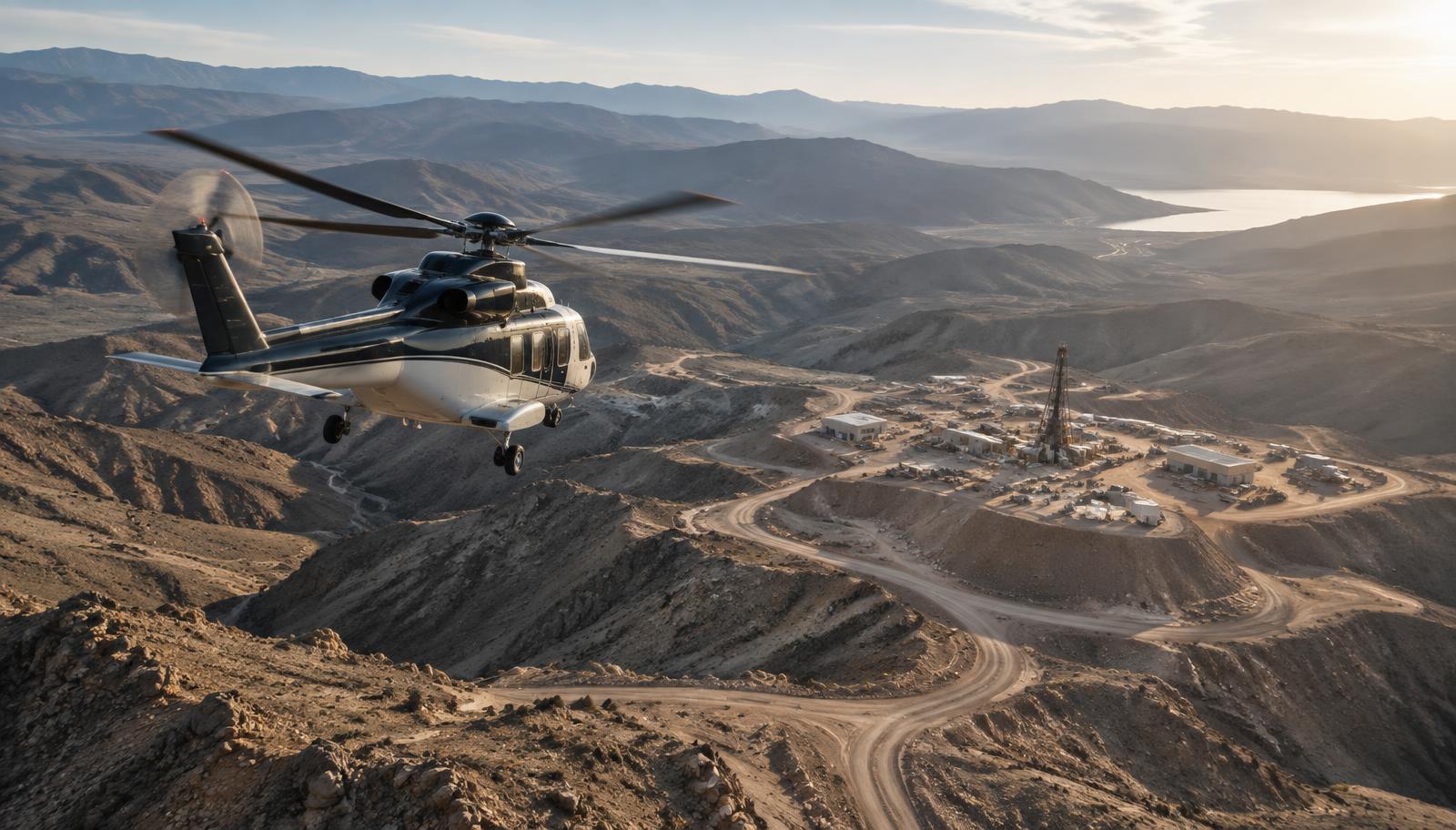
A helicopter mission is rarely justified by comparing an aircraft hour with a vehicle hour. The comparison that holds up internally is the working day: a site that costs two road days for six people costs those people twelve working days per visit. Compress the travel into two short sectors and most of that time returns to the project. Add schedule certainty, fewer overnight stays, reduced night driving on poor roads, and the ability to hold a decision meeting on site the same day, and the case is operational rather than cosmetic.
None of that makes a flight cheaper than a drive. It makes the access decision a productivity and risk decision, which is how experienced project teams present it.
Project access and time-savings calculator
The existing SkyMatch calculator compares a published road time with an estimated helicopter sector, across your passenger count and project days, and returns the travel time saved and the person-hours recovered. If you enter your own hourly cost of team downtime, it will also show an indicative productivity value using your figure — no assumed rate is invented for you.
Remote project time-saved calculator
Inputs: road time one way, estimated helicopter sector, passengers, project days or rotations, your own downtime cost (optional), urgency and whether several sites are involved. Output: travel time saved, person-hours recovered and an optional indicative value based only on the figure you provide.
This tool does not provide a helicopter quote. Aircraft availability, permissions, weather, landing access and operator terms must be reviewed.
Multi-site and multi-day planning
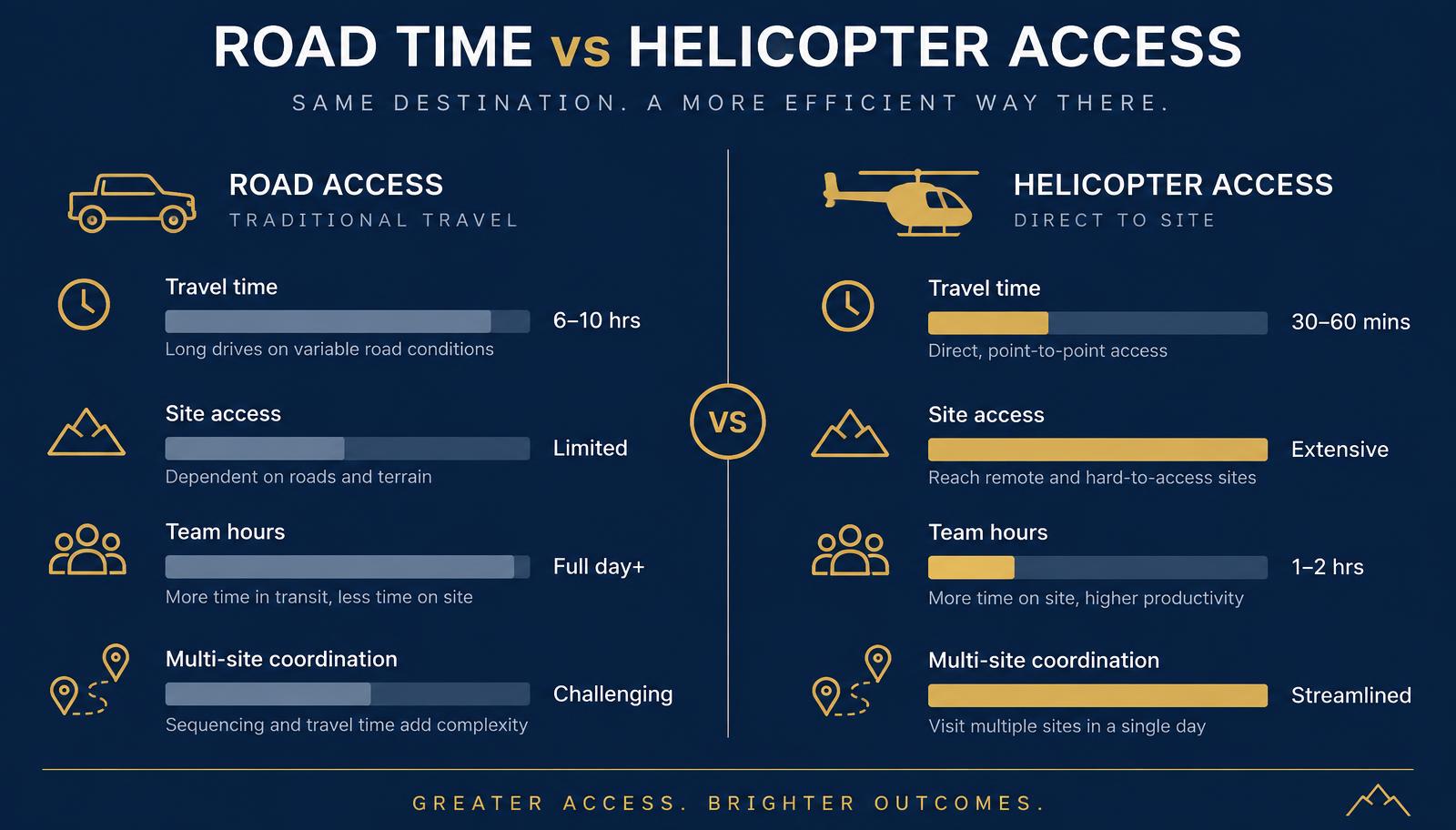
Multi-stop days are built backwards from the constraints: daylight, crew duty, fuel points, and the ground time each site genuinely needs. Two sites in a morning is often realistic; five sites across a region usually is not, once marshalling, security induction and weather margin are included. For longer programmes the question becomes basing — whether the aircraft returns to base each night or stays near the project, which changes crew accommodation and positioning cost.
Planning support: multi-site business day planner, executive site visit planner and multi-site infrastructure logistics guide.
FBO-to-site coordination and landing feasibility
Most corporate missions start at an airport or FBO and end at something that is not an airport: a project helipad, a cleared area, a yard or a landowner's field. That final leg is where feasibility is decided. Surface, slope, obstacles, downwash over equipment or vehicles, crowd and traffic control, and the consent of whoever controls the ground all matter — and local regulation governs whether a non-aerodrome landing is permitted at all. Coordinates and photographs are worth more than any description.
How SkyMatch coordinates a helicopter mission
- Submit mission requirements — route, stops, dates, people, equipment and site constraints.
- Human review of the operational need, with missing detail identified and completed.
- Suitable licensed operator sourcing in the relevant region and work class.
- Feasibility, permissions and aircraft-fit review by the operator.
- Quote and coordination, subject to availability, weather and approvals.
SkyMatch is an independent global helicopter charter broker and aviation concierge for companies. It does not own or operate aircraft and is not an airline. Aircraft, availability, landing permissions, permits, route feasibility and final pricing are confirmed by the licensed third-party operator after review.
Frequently asked questions
What does a corporate helicopter mission to a remote site cost?
There is no per-seat rate. The operator builds the price per mission from block time including positioning, aircraft class, crew, fuel, landing and handling, and ground or standby time. Positioning is often the largest single element on remote work. Indicative figures are planning aids only; the operator's quotation is the price.
Can one helicopter serve several project sites in a day?
Often yes, and it is one of the strongest reasons companies charter. Feasibility depends on sector lengths, ground time at each stop, fuel availability, landing permissions at every point, daylight and crew duty limits. Where the sequence does not fit, a fuel stop, a second aircraft or an overnight is the honest answer.
How are larger project groups moved?
Either with a larger aircraft where one is available in the region, or with rotations or multiple helicopters, subject to operator review. Group size, baggage, site capacity and landing-area limits all affect what can be offered. Nothing about multi-aircraft planning is confirmed until operators have assessed the plan.
Can equipment and baggage travel with the team?
Light equipment and essential baggage usually can, within the payload budget shared with fuel and passengers. Long, heavy, fragile or hazardous items need to be declared early because they may change the aircraft or require a separate movement. Provide a weight list rather than a description.
How quickly can an urgent project mobilisation be arranged?
Urgent requests are reviewed immediately and put to operators covering that region, but no response time or outcome is promised. Aircraft and crew availability, weather, landing permissions and regulatory approvals decide what is possible. Earlier notice always widens the set of operators that can support the task.
Is SkyMatch the operator of these flights?
No. SkyMatch is an independent global helicopter charter broker and aviation concierge for companies. It coordinates reviewed requests with licensed third-party operators and owns no aircraft. The operator confirms aircraft, feasibility, landing permissions, permits and final pricing.
Related SkyMatch pages
Plan Your Helicopter Mission
Send us the route, date, people, equipment and mission requirements. Our team will review the request and coordinate suitable licensed operators.
Plan Your Helicopter Mission