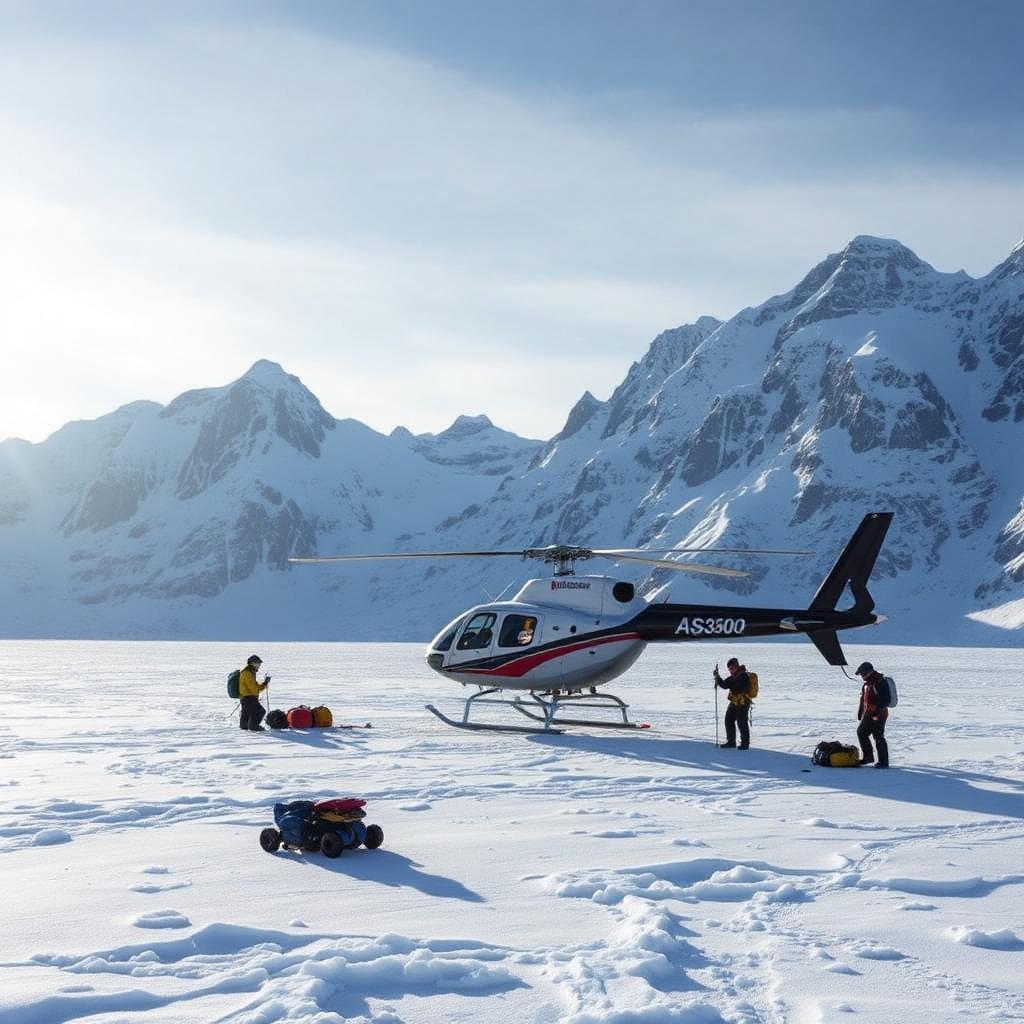
Remote Access & Expedition
A remote-access mission uses a helicopter to move people and equipment to places without practical road or airfield access: polar or high-altitude expeditions, research camps, and remote mining or project sites. It is bought by expedition organisers, research institutions, film crews and project companies. SkyMatch, an independent broker, takes the plan to licensed operators; the operator confirms the aircraft's performance for the altitude and temperature, fuel planning, landing sites and approvals.
Comparing aircraft for this mission? See the helicopter guide for categories, cabin and payload trade-offs. Equipment and approvals are confirmed by the operator.
Typical use cases
- Scientific and film expeditions in polar or high-altitude terrain
- Crew rotations to remote mining and survey sites
- Camp and equipment moves where no road exists
Compliance & crew
The operator must hold the approvals for the area (for example mountain, polar or remote landings), plan fuel and alternates, and carry the survival and communications equipment the operation requires.
Before you request a Remote & Expedition mission
Who usually buys it
- Expedition organisers
- Research institutions
- Film and production crews
- Mining and project companies
What the operator must hold or confirm
- Aircraft performance for the altitude, temperature and load
- Fuel planning, caches and alternates
- Landing sites and any area permits
- Communications and survival equipment
How it differs from other missions
Unlike heavy lift, loads usually travel inside the cabin and the flight carries people. Unlike a resort transfer, the landing site is often unprepared and fuel must be planned.
What it depends on
- Weather windows
- Fuel availability along the route
- Permits for protected or restricted areas
Limitations
- Performance falls as altitude and temperature rise
- Weather can hold flights for days
- Some protected areas do not allow landings
What to include in your request
- Location(s): departure point, work site or landing area, with an address or map pin
- Dates or time window, and how flexible they are
- Aircraft category if you already know it (light single, light or medium twin, heavy)
- People and payload: number of people, weights, and size of any equipment or load
- Equipment you require for the mission, as specified by your team
- Approvals or permits you need, or already hold, for the site or the work
- Safety, insurance and document requirements you want the operator to meet
- Who approves the request and how to reach them
Read the remote-site helicopter charter guide, build the brief in the mission planner, or send a request. Company missions can follow the business mission request checklist.



Frequently asked questions
Can a helicopter operate at high altitude?+
Performance falls as altitude and temperature rise, so the operator calculates what can be carried for your sites and season and confirms the aircraft.
How much notice do expedition flights need?+
It depends on fuel, permits and where aircraft are based; the operator advises when it quotes. Early requests leave more options.
Can heli-ski or yacht-based support be arranged?+
It can be requested; the operator and, where needed, local authorities confirm whether landings are allowed in the area.
Ready to launch a Remote & Expedition mission?
Share the brief: SkyMatch structures it and takes it to licensed operators, who confirm the aircraft, approvals, price and availability.
Prepared by the SkyMatch editorial team · How we source and review · Method
Share this article