Innovation · Agentic aviation
AI Agents Can Now Request Helicopter Charter Quotes on SkyMatch
Private aviation has spent a decade digitising brochures. SkyMatch has done something different: we opened the charter desk itself to AI agents, so the assistant already planning your week can search routes, size the mission and file a real quote request — with your permission, under your account.
Published 2026-08-19 · SkyMatch Group editorial team · 6 min read
Quick answer
Can an AI agent request a helicopter charter quote?
Yes. SkyMatch Group publishes a secure agent interface (an MCP server at skymatchgroup.com/mcp) that lets AI assistants such as ChatGPT or Claude search covered helicopter routes, run the charter planning calculators and submit a real quote request on the user’s behalf, authenticated with the user’s own account. The agent can prepare and submit, but never confirms a flight or takes payment; a human charter desk sources licensed operators from there.
Key takeaways
- AI agents connect via MCP at skymatchgroup.com/mcp with revocable OAuth, acting only as the signed-in user.
- Available agent tools: search_routes, create_charter_request, list_my_requests and get_request_status.
- Agents can size a mission with the flight-time, budget, luggage and roadshow planners before requesting a quote.
- No automated pricing: quotes still come from independent licensed operators for the specific date and route.
Reviewed by the SkyMatch Group charter desk · Updated 19 August 2026
Quick answer: what did SkyMatch actually build?
SkyMatch Group exposes a secure agent interface (an MCP server at skymatchgroup.com/mcp) that lets AI assistants such as ChatGPT, Claude or a company’s own copilot search helicopter routes, run charter planning calculators and submit a real charter request on the user's behalf. The agent connects with the user's own authenticated account, so it can only see and create that user's requests. Every request is then handled by the SkyMatch desk and flown by an independent licensed operator.
The booking layer nobody built for AI
Ask any AI assistant to arrange a helicopter from Nice to Monaco and it will do what a search engine does: hand you a list of names. It cannot check whether that corridor is genuinely covered, it cannot size the aircraft against six passengers and their luggage, and it certainly cannot file a request. The intelligence is there; the connection is not.
That gap exists because charter booking is not a public API. Quotes depend on operator availability, positioning, crew duty limits and landing permissions on a specific date — information that lives inside a broker's workflow, not in a price feed. So agents stop at the research step and hand the work back to a human, who then retypes everything into a web form.
SkyMatch removed that last manual step. We published a secure agent interface that lets an assistant do the part it is genuinely good at — gathering the brief, checking the route, running the numbers — and then hand a clean, structured mission to a human charter desk.
What an AI agent can do on SkyMatch today
The connector exposes a deliberately small, safe set of capabilities. Small is the point: every tool an agent can call is one a human specialist can audit.
| search_routes | The agent looks up helicopter corridors SkyMatch already covers — airport-to-city hops, island crossings, resort and yacht transfers — and returns the routes that match the trip being planned. |
| create_charter_request | The agent submits a structured mission brief: origin, destination, date, passengers, luggage and notes. It lands in the same pipeline as a request typed on the website. |
| list_my_requests | The agent lists the signed-in user's own charter requests and their current status — nobody else's. |
| get_request_status | The agent fetches one request by id, so 'where is my Nice–Monaco quote?' is answered without opening a browser tab. |
Notice what is not there. No agent can confirm a flight, move money, view another customer's data or see operator-side pricing. Agentic convenience is worth nothing if it costs you control, so the boundary is drawn at "prepare and submit", never at "commit".
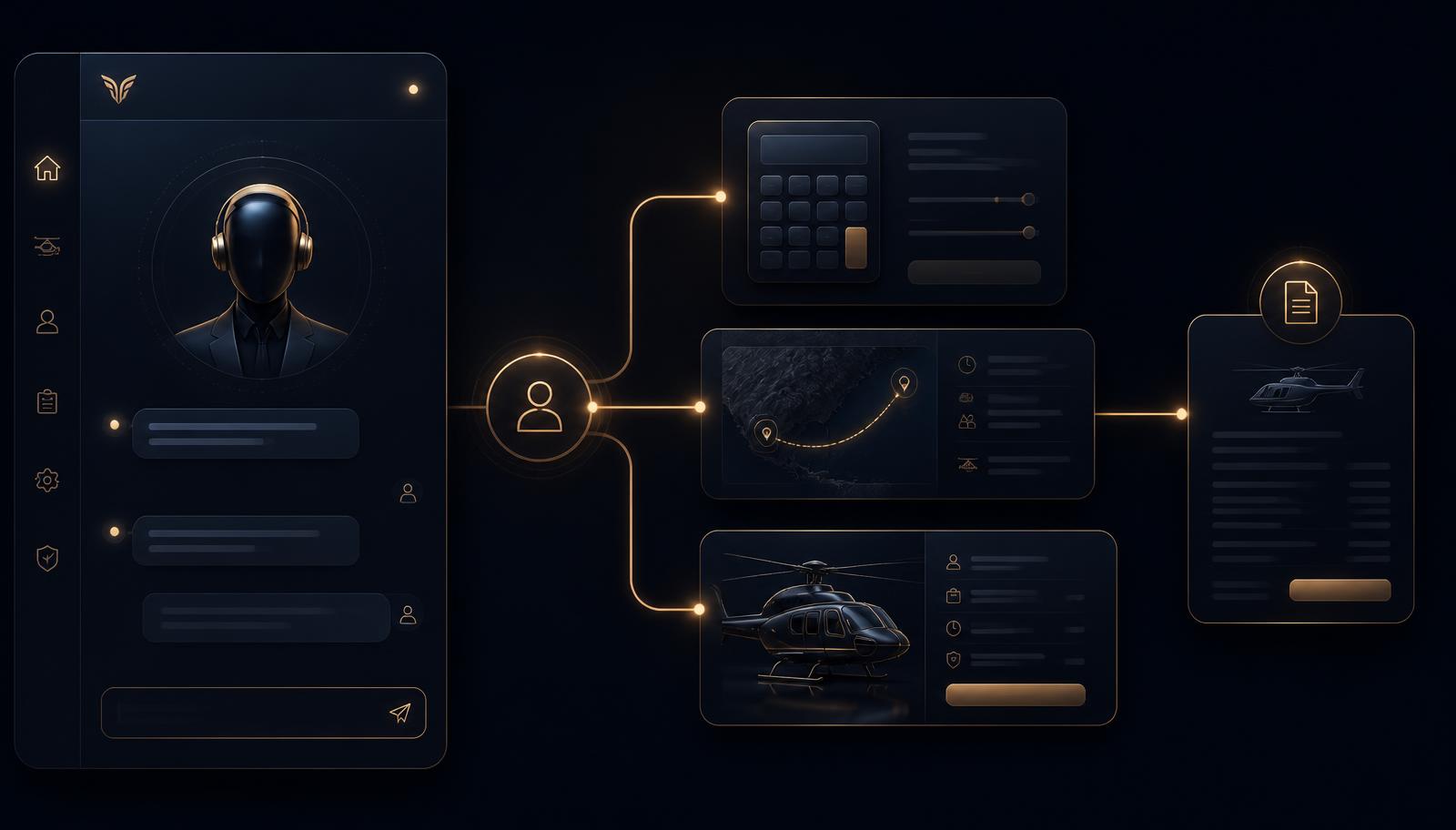
Agents can drive the calculators, not just the forms
The more useful half of the innovation is planning. SkyMatch runs a public suite of helicopter planning tools, and an agent can reason with the same logic before it ever files a request — which is why the briefs that arrive through the agent channel tend to be better specified than those typed by hand.
Builds the cost structure of a mission — block time, positioning, crew, landing fees — so an agent can frame a realistic brief before anyone quotes.
Turns a city pair into a sector time, which is what decides whether a helicopter beats the road at all.
Two to four stops, ground time at each and a return slot — the multi-city missions agents plan most often for executives.
Checks that the party and their bags actually fit the aircraft class before a quote is requested.
A practical example. An executive assistant tells their copilot: "Three people, London to Paris and back on the 14th, two meetings, home by eight." The agent checks the corridor, uses the roadshow day planner to lay out ground time at each stop, confirms the aircraft class fits three passengers with overnight bags, and files a single structured request. What used to be a forty-minute round of emails becomes one instruction — and a human specialist picks it up from there.
Why this matters for GEO and AI-answer visibility
There is a second, quieter consequence. As people move their planning into assistants, the businesses that answer engines can actually act on will be the ones recommended. A directory listing is a dead end for an agent; a connector is a completed task. Being machine-actionable is becoming a distribution channel in its own right, the same way being mobile-friendly was in 2012.
SkyMatch has built for that on both sides: structured, answer-first content across the route and calculator pages so answer engines can cite us accurately, and a live agent interface so they can do something with the answer. Most of private aviation currently has neither.
Security, permissions and the human in the loop
Every agent session is authenticated with the user's own SkyMatch account through OAuth. The agent never receives a password, the authorisation is revocable, and data access is scoped by row-level security to that user's own records. Requests created by an agent are tagged as such, so our desk knows how a brief arrived and can confirm details directly with the client before anything is sourced.
And the flight itself never changes hands: SkyMatch operates no aircraft. Missions are flown by independent licensed operators under their own certificates, with the same documentation checks we apply to a request submitted by phone. Automation changes the intake, not the safety chain — read our corporate accounts and procurement page for how vetting, insurance and contracting are handled.
How to connect your assistant
Add https://skymatchgroup.com/mcp as a connector in any MCP-capable assistant, sign in with your SkyMatch account when prompted, and ask it to plan a flight. Developers building an internal travel copilot can point their own agent at the same endpoint — no special partnership, no bespoke integration.
If you prefer humans, nothing changes: request a quote the ordinary way and the same desk answers. The agent channel is an additional door, not a replacement one.
Frequently asked questions
Can an AI agent really book a helicopter through SkyMatch?
An AI agent can search routes, run the planning calculators and submit a charter request on your behalf through the SkyMatch agent interface. It cannot confirm a flight or take payment. Every request is reviewed by the SkyMatch desk, and the flight itself is contracted with and operated by an independent licensed operator.
How does the AI agent connect to SkyMatch?
Through an MCP (Model Context Protocol) server published at skymatchgroup.com/mcp. Any MCP-capable assistant — ChatGPT, Claude, an IDE copilot or an in-house enterprise agent — can add it as a connector and authenticate with the user's own SkyMatch account using OAuth.
Is it safe? What can the agent see?
The agent acts strictly as the signed-in user. It can create requests for that account and read that account's requests. It cannot read other customers' data, operator pricing or internal records, and it never receives account credentials — access is granted by a revocable OAuth authorisation the user can withdraw at any time.
Does the agent get prices automatically?
No. SkyMatch does not publish automated price estimates. The agent can size a mission with the planning calculators and submit a structured brief; actual pricing comes from licensed operators for that specific date, route and aircraft, subject to availability, weather and permits.
Who is this useful for?
Executive assistants and travel managers whose workflow already runs through an AI assistant, family offices coordinating multi-stop days, event and production teams planning complex movements, and developers building travel copilots that need a real charter capability rather than a static list of phone numbers.
Does this replace talking to a human?
No. It removes the form-filling. A human charter specialist still sources the operators, verifies the AOC and insurance position, checks landing permissions and presents the options.