Helicopter vs car vs private jet for trips under 400 km
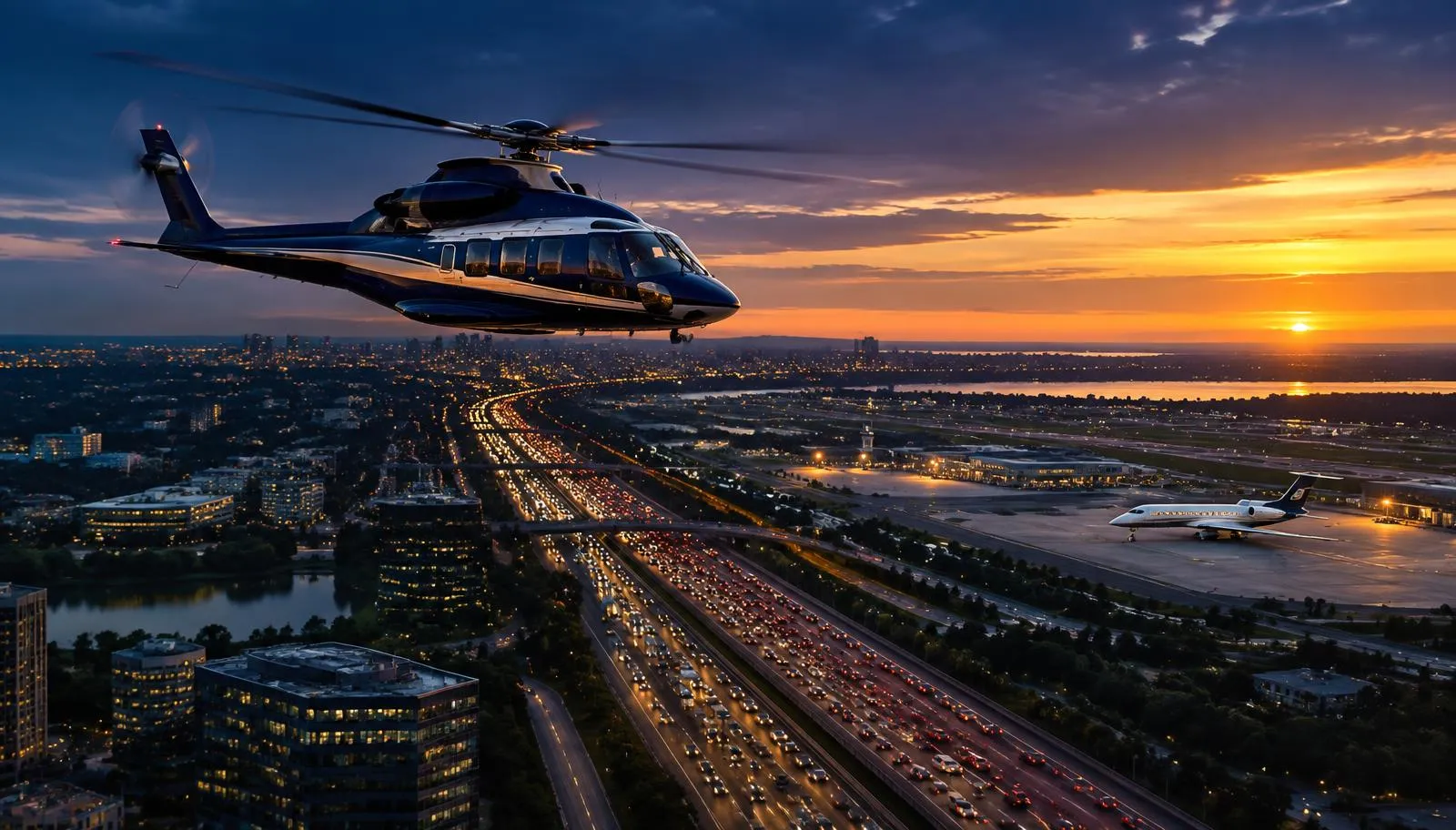
For journeys under about 400 km, the fastest aircraft is not necessarily the fastest way to arrive. Road geography, airport access, landing permissions and your required arrival time matter more than cruise speed alone. This guide explains how to compare realistic itineraries before making a helicopter transfer booking. SkyMatch Group is an independent broker and mission concierge that sources licensed operators; it does not own or operate aircraft.
1. When does a helicopter genuinely save time?
A helicopter is most compelling when it bypasses an awkward road journey and uses suitable landing sites near your actual departure point and destination. Congested city approaches, indirect mountain roads, coastal routes and destinations separated by water can create a strong case. Distance alone is a weak guide: a relatively short flight may replace a much longer road itinerary, while a straightforward motorway journey can leave little time to recover.
Proximity must be verified, not assumed from a map. A hotel lawn, event field or private estate is not automatically an authorised landing site. Every landing must be confirmed by the licensed operator and may require permission. Include the final car connection where direct access is unavailable. A helicopter taxi offers its strongest advantage when both ground legs stay short and the operating schedule suits your appointment.
2. When should you choose a car or private jet instead?
Choose a car when the road journey is direct, departure timing may change, or neither endpoint has practical helicopter access. It also simplifies bulky luggage, multiple stops and late finishes. Driving is not immune to weather or disruption, but it avoids aviation-specific departure and landing constraints. For a central-city meeting, an aircraft itinerary with lengthy transfers at both ends can add complexity without delivering meaningful time savings.
The private helicopter vs private jet decision depends heavily on airports. A jet can make sense when you already arrive at an airport, your destination is close to another suitable airport, or cabin and baggage requirements favour an appropriate aircraft. Over short sectors, taxiing, climb, descent and airport procedures erode the cruise-speed advantage. Compare specific aircraft and schedules: not every jet has generous baggage capacity, and not every helicopter accommodates the same party.
3. Calculate the full door-to-door journey
Use one common starting point and finish line: ready to leave your address, then ready to enter your meeting or venue. For aviation, add ground access, the operator’s reporting allowance, passenger processing, boarding, estimated airborne time, arrival handling and the final transfer. Ask whether a quoted duration means airborne time or includes ground movement. For driving, include traffic at the relevant hour, planned stops, parking and the walk to your destination.
For illustration only, an estimated helicopter itinerary might include 20 minutes to the departure site, 25 minutes for reporting and boarding, an estimated 45-minute flight, and 20 minutes for unloading and onward travel: approximately 110 minutes overall. That comparison is useful only against a realistic same-day driving estimate. Add a disruption margin separately, and ask about refuelling or intermediate stops. Aircraft speed alone cannot establish the winning itinerary.
4. Check weather, daylight and operational limits
Helicopters do not simply fly beneath any weather that grounds other aircraft. Visibility, cloud, wind, thunderstorms, icing conditions, terrain and landing-site characteristics can affect feasibility. Some operations require visual flight conditions; others may use instrument procedures where aircraft, crew, approvals and infrastructure permit. An instrument-capable helicopter does not make every destination accessible in poor weather, especially where the final landing depends on suitable visual conditions.
Night flying is possible in appropriately equipped and approved operations, but a daytime landing site may not be usable after dark. Ask the licensed operator to assess both departure and return, including seasonal daylight, site lighting, airport opening hours and any applicable restrictions. Treat all flight times as estimates. For a fixed deadline, allow a realistic buffer and agree a ground alternative, including who activates it if conditions prevent flying.
5. Assess airport-to-city and event transfers carefully
A helicopter airport transfer can remove a difficult road leg after an airline or private-jet arrival, but the connection itself takes time. Immigration, customs, baggage collection and movement to the helicopter departure point may remain necessary. Do not assume an airside connection is possible. Ask for the actual transfer sequence, an allowance for inbound delays and the final drive from the city landing site; a remote heliport can undermine the benefit.
For races, festivals, weddings and major sporting events, road queues can favour helicopter access, but arrival near the venue is not guaranteed. Temporary sites may need permissions, operating arrangements and allocated movements, while the last mile can still involve a shuttle and security screening. Check the return plan against the event’s likely finishing time, daylight and site restrictions. A nearby landing is valuable only if passengers can reach their seats or hospitality entrance efficiently.
6. Request comparable proposals and choose the resilient option
Ask for car, helicopter and jet options against the same addresses, passenger list, baggage details and arrival deadline. Request the proposed aircraft type, usable baggage allowance, confirmed or provisional landing arrangements, estimated door-to-door schedule and ground-transfer responsibilities. Before you charter a helicopter, distinguish permissions already obtained from those still pending. A proposal should make assumptions and operational dependencies visible rather than presenting only an attractive estimated flight duration.
Choose the option that delivers a worthwhile time saving with acceptable complexity and a credible fallback. Review cancellation, weather disruption, waiting and itinerary-change terms, plus what happens if an inbound service runs late. Prices are on request and depend on operator, aircraft, positioning and date. SkyMatch coordinates sourcing and mission details with licensed operators; availability, permissions and operational acceptance remain subject to confirmation, and the operator makes flight-operational decisions.
Checklist before you request a quote
- Provide exact departure and destination addresses, not just city names.
- State travel dates, arrival deadlines and flexibility for both journey legs.
- List passengers and provide weights if requested for operational planning.
- Describe luggage dimensions, quantities, sports equipment and accessibility needs.
- Identify potential landing sites and contacts, without assuming landing approval.
- Share inbound flight details and likely event finishing times.
- Request transfer responsibilities, disruption terms and a workable ground backup.
Frequently asked questions
Is a helicopter always faster than a car under 400 km?
No. A helicopter is faster door to door only when the road time avoided exceeds ground access, reporting, boarding, the estimated flight and onward travel. Direct roads and inconvenient landing sites can favour driving. Compare exact addresses and the relevant travel hour rather than distance or aircraft cruise speed.
Is a private helicopter better than a private jet for short trips?
A private helicopter can be better when suitable landing sites bring passengers closer to their destination. A private jet may suit airport-to-airport journeys or particular cabin and baggage needs. For short trips, compare the complete itinerary: higher cruise speed does not necessarily overcome airport access and ground procedures.
Can a helicopter land at my hotel or event venue?
Possibly, but available space does not establish suitability or permission. The licensed operator must confirm every landing and assess factors such as obstacles, surface, approach paths and local restrictions. Landowner consent and additional permissions may be needed. Keep an alternative landing site and onward road transfer in the plan.
Can I book a helicopter transfer after dark?
Night transfers may be possible when the aircraft, crew, operation and landing sites meet the applicable requirements. A site used during daylight may be unsuitable at night. Ask for the proposed return journey to be assessed explicitly, and retain a ground alternative if timing or conditions make flying impractical.
How much time should I allow after an airline arrival?
There is no universal connection allowance for a helicopter airport transfer. Immigration, customs, baggage delivery, terminal location and the permitted transfer route all matter. Provide the inbound flight details and baggage information, then request a realistic connection plan with delay contingencies. Do not assume helicopter boarding follows immediately after airline arrival.
What does SkyMatch need to arrange a helicopter quote?
SkyMatch needs your route, date, preferred timings, passenger details, luggage and any special requirements. Exact addresses help evaluate genuine door-to-door value. SkyMatch is an independent broker and mission concierge sourcing licensed operators, not an aircraft operator. Prices are on request and depend on operator, aircraft, positioning and date.
Prices on request. Flight times are estimates. Every landing is confirmed by the licensed operator. SkyMatch is an independent broker and does not operate aircraft.
Read next:How to charter a private helicopter: a step-by-step buyer’s guide
Request a quote for your short-trip transfer
Send SkyMatch Group your addresses, travel date, passenger details and arrival deadline. Request a tailored proposal with estimated journey timings, landing requirements and onward transfers. Prices are on request; availability and operational feasibility are subject to confirmation.