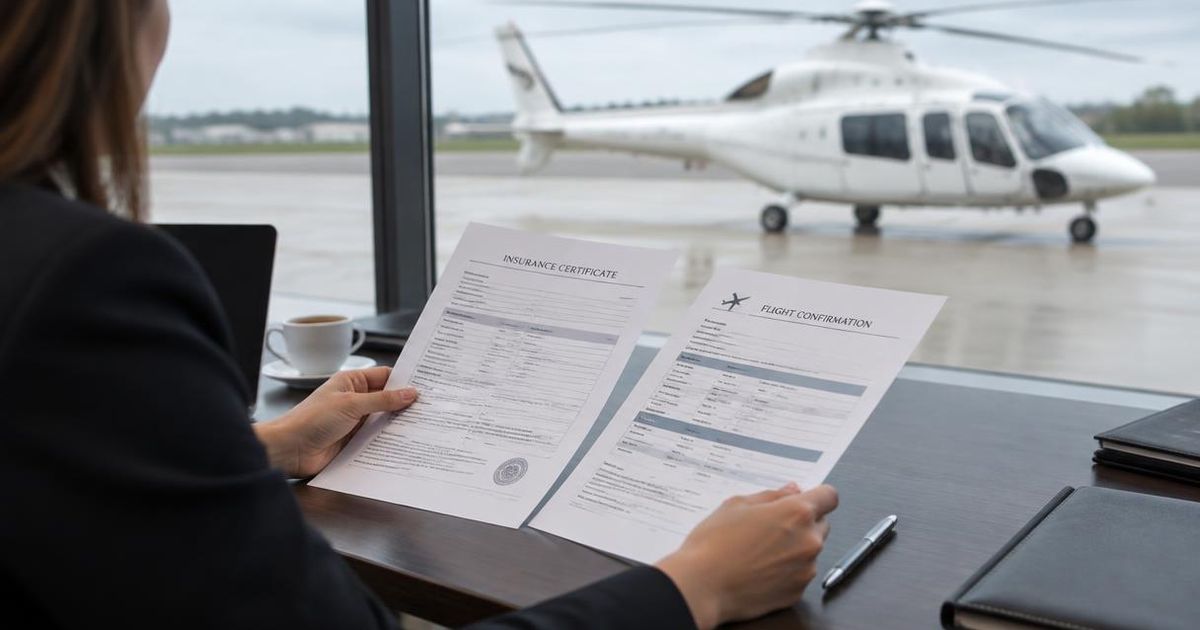
Helicopter charter insurance and broker disclosures: what to ask for before you sign
The aviation liability insurance for a charter flight is held by the aircraft operator — the company with the air operator certificate and operational control of the flight — not by the broker or the passenger. Before you sign, ask for three things in writing: the name of the operator that will fly you, the capacity in which the broker is acting, and evidence that the operator's insurance is valid for your date, rout
- Several parties can hold insurance that matters to a charter, and they cover different risks.
- In the European Union, Regulation (EC) No 785/2004 sets minimum insurance requirements for air carriers and aircraft operators flying within, into, out of or over the territory of a Member State.
- In the United States, the Department of Transportation's rule for air charter brokers, 14 CFR Part 295, applies to brokers that arrange single-entity charters.
- Ask the operator, through your broker, for evidence of insurance that answers each of these points: The insured party is the operator named in your confirmation — the same company that holds the certificate for the fligh
The aviation liability insurance for a charter flight is held by the aircraft operator — the company with the air operator certificate and operational control of the flight — not by the broker or the passenger. Before you sign, ask for three things in writing: the name of the operator that will fly you, the capacity in which the broker is acting, and evidence that the operator's insurance is valid for your date, route and aircraft. This guide explains who insures what, what the rules in the EU and the United States say, and which documents a company buyer should request.
Who insures what on a chartered helicopter flight
Several parties can hold insurance that matters to a charter, and they cover different risks. Ask each one directly rather than assuming.
| Party | Typical role | What to ask |
|---|---|---|
| Aircraft operator (certificate holder) | Operates the aircraft and holds the aviation liability insurance required by its regulator | Evidence of insurance covering passengers, baggage and third parties for your date, aircraft and countries |
| Broker or concierge | Arranges the flight and acts as your point of contact | In what capacity it acts, and whether it holds any liability insurance of its own and on what limits |
| Your company | Sends employees or guests on the flight | Whether your own corporate, travel or event policies respond to chartered private flights |
| Event organiser or venue | Controls a landing site or programme | Whether it imposes its own insurance or indemnity conditions on aircraft using the site |
The operator's aviation insurance is the cover regulators require for the flight itself. A broker's own insurance, if it has any, does not replace it, and your company's travel policy may or may not extend to chartered private flights — the wording of each policy decides.
What EU law requires of air carriers and aircraft operators
In the European Union, Regulation (EC) No 785/2004 sets minimum insurance requirements for air carriers and aircraft operators flying within, into, out of or over the territory of a Member State. In summary:
- The operator must be insured for its aviation-specific liability in respect of passengers, baggage, cargo and third parties (Article 4).
- The insured risks must include acts of war, terrorism, hijacking, sabotage, unlawful seizure of aircraft and civil commotion (Article 4).
- Minimum cover is set per passenger for passenger liability (Article 6) and per accident for third-party liability, scaled by the aircraft's maximum take-off mass (Article 7).
- Operators demonstrate compliance by depositing an insurance certificate or other evidence of valid insurance with the competent authority (Article 5).
The regulation sets a floor, not a recommended level. Your risk or legal team decides whether a higher limit is needed for your passengers or for work near people and property on the ground.
What US rules require a charter broker to disclose
In the United States, the Department of Transportation's rule for air charter brokers, 14 CFR Part 295, applies to brokers that arrange single-entity charters. Its advertising section (§ 295.23) requires brokers to state that they are brokers, not the air carrier in operational control, and that the flight will be provided by a properly licensed carrier. Its disclosure section (§ 295.24) requires a broker, before a contract for a specific flight, to tell the charterer:
- the corporate name of the carrier in operational control of the aircraft;
- the capacity in which the broker is acting — for example as agent of the charterer or agent of the carrier;
- whether the broker holds liability insurance covering the charterer, passengers and property, and its limits.
On request, the broker must also disclose the total cost of the flight paid to or through the broker, known third-party fees you will pay directly, and — when it acts as your agent — any business relationship with the carrier that could influence its choice. Outside the United States these exact duties may not apply, but they are a useful checklist for any charter purchase.
The insurance evidence a company buyer should request
Ask the operator, through your broker, for evidence of insurance that answers each of these points:
- The insured party is the operator named in your confirmation — the same company that holds the certificate for the flight.
- The aircraft registration on the evidence matches the aircraft offered, or the policy clearly covers the operator's fleet.
- The policy period covers your flight date, including a possible weather day.
- The territorial limits cover every country you will take off from, land in or overfly.
- Passenger, baggage and third-party liability are covered, with limits stated.
- For industrial work — slung loads, work near structures or crowds — the cover extends to that activity, not only to passenger transport.
- Any wording your company requires, such as being named as an additional insured or a waiver of subrogation, is requested early: it can take the operator's insurer time to issue, and some operators may decline.
Keep the evidence with the booking record. If the aircraft or operator changes, ask for fresh evidence before you accept the change.
Red flags before you pay
The US Federal Aviation Administration's guidance for charter customers advises asking to see the operator's certificate before you pay, and lists warning signs of an illegal charter. Several apply anywhere:
- The company will not show the operator's certificate or insurance evidence.
- A document tries to transfer operational control of the flight to you as the customer.
- Answers about who operates the aircraft are vague or keep changing.
- There is no passenger safety briefing on the day.
A licensed operator expects these questions. Evasion is a reason to stop, not to negotiate. Our guide to verifying a helicopter charter operator shows where to check certificates in several countries.
How SkyMatch handles this on your request
SkyMatch Group is an independent helicopter charter broker and concierge. It does not own or operate aircraft and is not an air carrier. On each request, SkyMatch asks licensed operators to quote; the licensed operator confirms the aircraft, availability, route, landing and price before anything is booked.
- Each proposal shows whether the price is an estimate or the operator's written quotation.
- Each proposal shows the status and date of the credential and insurance evidence SkyMatch has on file for that option. Ask for the documents themselves before you accept.
- Your written confirmation names the operator that will fly you.
Send your trip details through the quote form; state any insurance wording your company needs in the notes so it is requested with the quote, not after.
Sources
- Regulation (EC) No 785/2004 on insurance requirements for air carriers and aircraft operators — EUR-Lex, checked 24 October 2026.
- 14 CFR Part 295 — Air Charter Brokers, eCFR, up to date as of 22 October 2026, checked 24 October 2026.
- FAA — Thinking of chartering an aircraft?, page last updated 8 January 2026, checked 24 October 2026.
This guide summarises public rules for planning purposes. It is not legal or insurance advice.
Guide: helicopter landing permission and approved sites →
FAQ
Who insures a chartered helicopter flight, the broker or the operator?
The aircraft operator — the company in operational control of the flight — holds the aviation liability insurance its regulator requires. A broker may or may not hold liability insurance of its own; ask it to state whether it does and on what limits. One does not replace the other.
What should a helicopter operator's certificate of insurance show?
The operator's name as on its certificate, the aircraft or fleet covered, a policy period that includes your flight date, territorial limits covering your route, and passenger, baggage and third-party liability with stated limits. For slung loads or other aerial work, check that the activity itself is covered.
Can my company be named as an additional insured on the operator's policy?
You can ask. Whether the operator's insurer agrees, and how long it takes, varies. Put the request in the original brief so it is part of the quote rather than a last-minute condition.
Does my corporate travel insurance cover a chartered helicopter flight?
It depends on the policy wording. Some policies treat chartered private flights differently from scheduled airline travel. Ask your insurer or risk team before the trip; the operator's aviation insurance is a separate cover.
Do the US broker disclosure rules apply to every charter?
14 CFR Part 295 applies to air charter brokers arranging single-entity charters within its scope under US jurisdiction. Other countries have their own rules. Asking for the operator's name, the broker's capacity and insurance status is sensible wherever you book.
Conclusion
Before you sign, have three answers in writing: who operates the flight, in what capacity the broker acts, and evidence that the operator's insurance covers your date, aircraft, route and activity. Add any wording your company needs to the first brief, and keep the evidence with the booking.
Planning this flight?
SkyMatch is an independent broker. Every request is reviewed by our team before any operator is approached.
Before adding a new region or destination, check landing sites, permissions, weather patterns and local aviation capability. A step-by-step checklist with scoring.
How public-sector and government buyers source helicopter services: tender structure, compliance and security requirements, cleared operators, cross-border coordination, and audit-ready procurement.
Inside how multinational enterprises procure helicopter services: category strategy, framework RFPs, safety and insurance governance, and the operating model used by mature travel and mobility teams.
How SkyMatch reviews your helicopter charter request, arranges and manages the flight, and gives procurement one written proposal. Pricing on request.
SkyMatch intelligence digest
Get new articles by email
A short email digest of newly published guides, technology briefs and dated, sourced market updates on the topics you pick, each with a link to the full article. No price lists, no sales follow-up, and signing up never creates a quote request.